How to use the wall art size calculator
Start with what the art hangs over: a sofa, a bed, a console table, a dresser, a mantel or a bare wall. The furniture sets the size, so the calculator draws the right piece under your art and fills in typical measurements.
Next, check the width. Measure the sofa from arm to arm, the headboard or dresser from end to end, or the mantel shelf. For a bare wall, measure the open stretch of wall the art will own, from corner to corner or between a window and a door. Type it the way you would write it (7’ or 84”) or tap the minus and plus buttons. Switch to centimeters with the unit toggle if you prefer metric.
Then choose how many pieces: one piece, a pair or a set of three. Pick landscape or portrait. The size buttons cover the stock frame and canvas sizes you can buy off the shelf, from 8 x 10 to 40 x 60 inches. Each one turns green when it fits, amber when it is too small and red when it is too big. The size marked “Best” is the one closest to the middle of the ideal range.
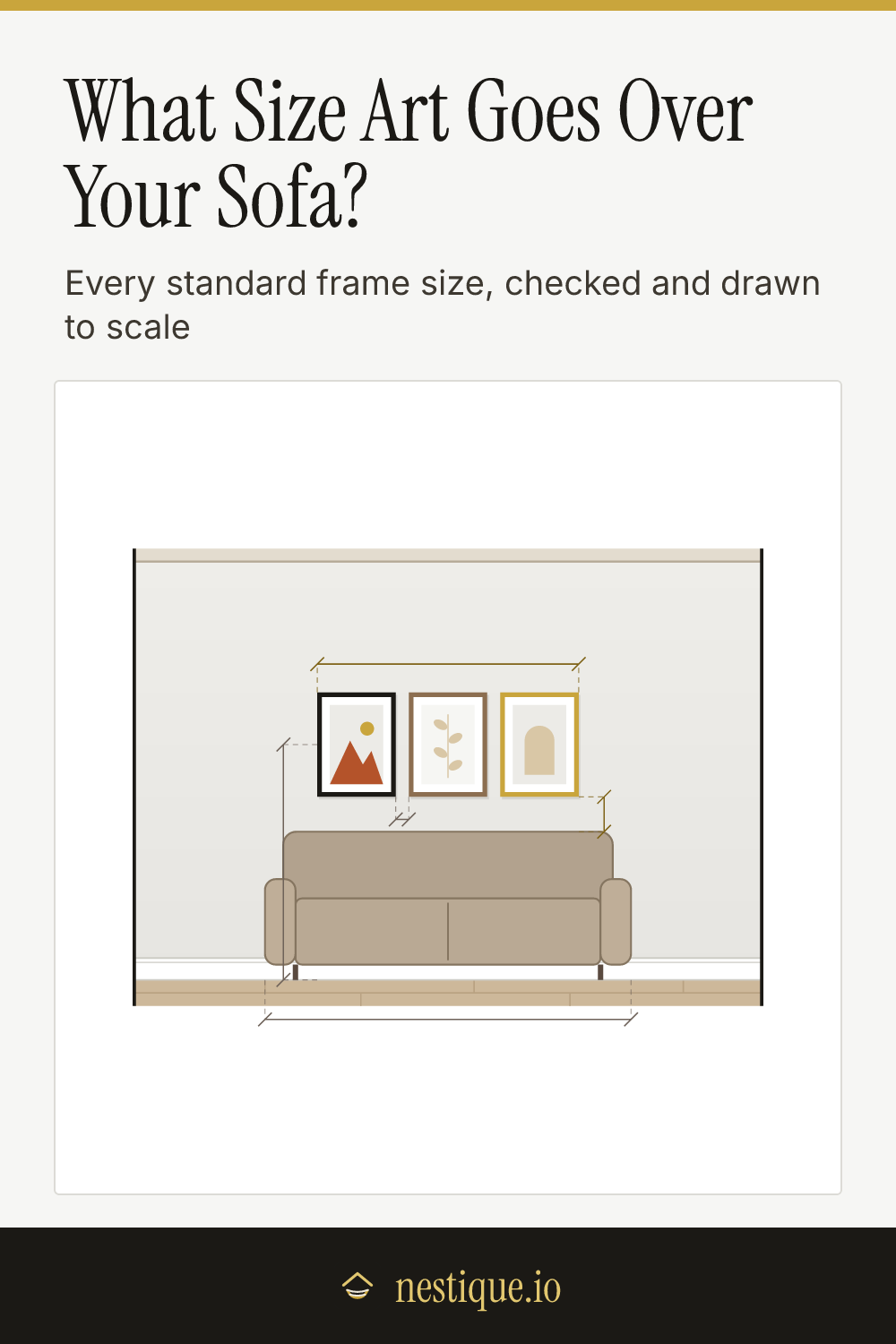
The drawing shows the art on your wall to scale, with its total width, the space above the furniture and the center height. The result panel tells you exactly where to put the bottom edge. Save it as an image to take to the frame shop.
The rules behind the sizes
These are the guidelines designers and framers repeat most often. None of them is a law, but together they explain why some art looks right and some looks lost.
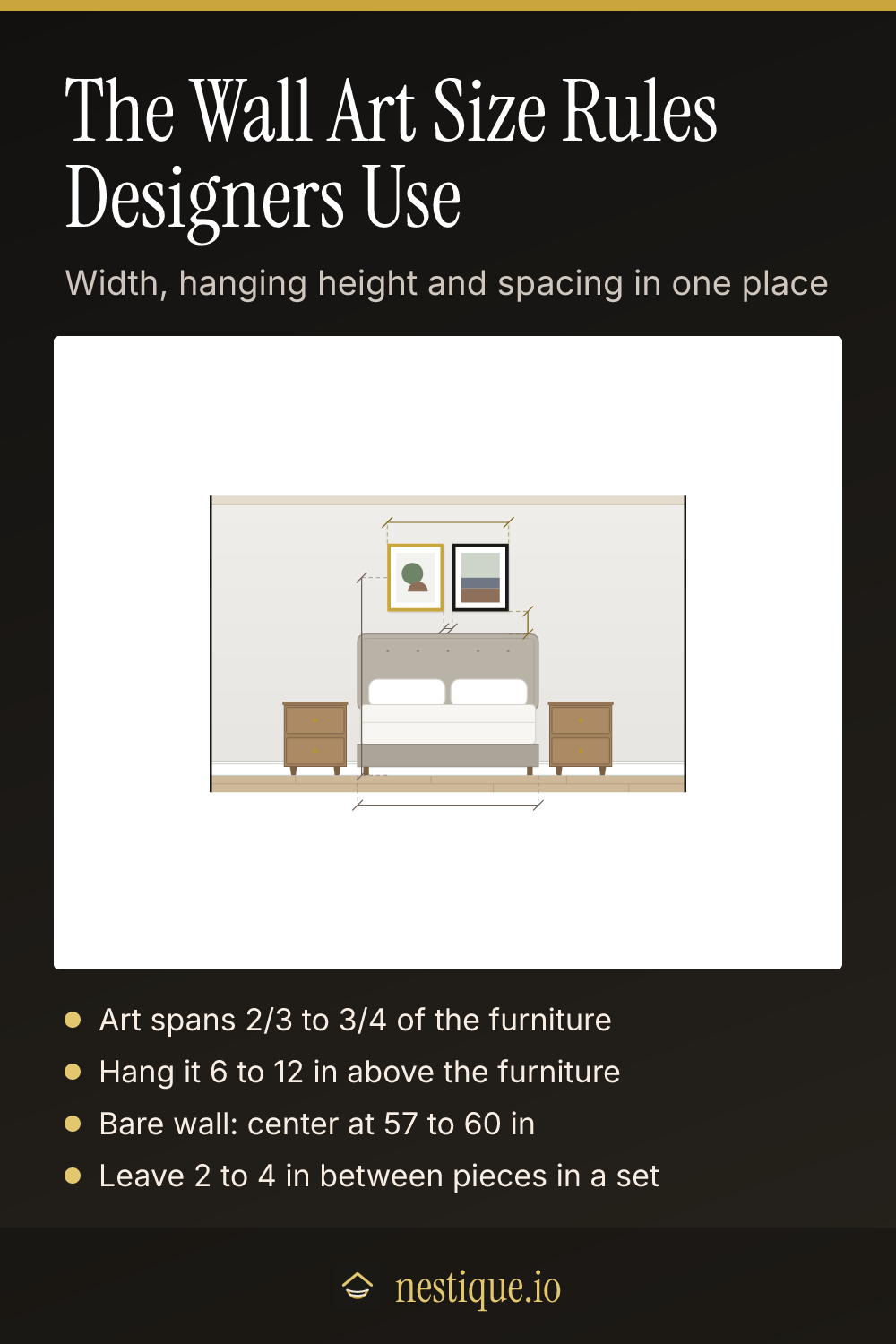
Two-thirds to three-quarters of the furniture. The overall width of the art should be about 2/3 to 3/4 of the width of the piece below it. Narrower and the art looks like an afterthought. Wider and it crowds the furniture and the lamps beside it. For a set, measure from the left edge of the first piece to the right edge of the last one, gaps included.
The same share of a bare wall. With nothing below it, the art relates to the open wall instead. The calculator uses the same 2/3 to 3/4 share of the wall width.
6 to 12 inches above the furniture. The bottom of the art should sit 6 to 12 inches above the sofa back, headboard, dresser or mantel shelf. That keeps the two pieces reading as one group. Eight inches is a good default. Over a sofa, go toward the top of the range so heads don’t touch the frame.
57 to 60 inches on center on a bare wall. Galleries hang art with its center at about 57 inches, which is eye level for most adults. In rooms with tall ceilings you can go up to 60 inches.
2 to 4 inches between pieces in a set. Tight gaps make a pair or a set of three read as one picture. Wider gaps split it apart.
Room to breathe at the top. The calculator flags any size that leaves less than 6 inches of wall under the ceiling. That usually happens with tall portrait pieces over a mantel.
Assumptions
The default furniture is typical: an 84 inch sofa with a 34 inch back, a queen headboard about 64 inches wide and 50 inches tall, a 48 inch console table 32 inches tall, a 60 inch dresser 34 inches tall and a mantel shelf at 54 inches. Change any of them to match yours.
Sizes are frame or canvas outside dimensions. A print sold as 18 x 24 inches gets bigger once it has a mat and frame, so measure the framed size if you are framing it yourself. Stock sizes come in steps, so a size within an inch of the ideal range still counts as a fit.
Art is centered over the furniture. The calculator does not model lamps, sconces or windows, so check those by eye.
Worked example
Say you have an 84 inch sofa with a 34 inch back, an 8 foot ceiling and art hung 8 inches above the sofa.
- The ideal width is 56 to 63 inches, which is two-thirds to three-quarters of 84 inches.
- One 36 x 48 inch piece hung sideways is too small. At 48 inches wide it covers only 57% of the sofa.
- One 40 x 60 inch canvas hung sideways fits. It is 60 inches wide, 71% of the sofa. The bottom edge goes at 42 inches, the center lands at 62 inches, and there are still 14 inches of wall above it.
- A pair of 30 x 40 inch prints works too, hung upright with 3 inches between them. Together they span 63 inches, right at the top of the range.
- A set of three 18 x 24 inch prints with 3 inch gaps spans 60 inches, almost dead center in the range.
All three good options leave the same 8 inches of wall over the sofa back. Pick the one that suits the art you love.
Pin it for later
Wall Art Size Calculator FAQ
What size art goes over an 84 inch sofa?
Aim for art about 56 to 63 inches wide, which is two-thirds to three-quarters of the sofa. A 40 x 60 inch canvas hung sideways fits, and so do a pair of 30 x 40 inch prints or three 18 x 24 inch prints with 3 inch gaps.
How high should art hang above a sofa?
Hang the bottom edge 6 to 12 inches above the top of the sofa back, and 8 inches is a safe pick. Any higher and the art floats away from the sofa. Any lower and heads will bump it.
How high do you hang art on a wall with no furniture?
Put the center of the art 57 to 60 inches from the floor. That is about eye level for most adults, and it is the height most galleries and museums use.
Is it better to have one big piece or several small ones?
Either works if the overall width lands in the 2/3 to 3/4 range. A pair or a set of three is easier to find in stock sizes and easier to hang on a wide wall. One large piece reads calmer and works best when you can find a size that fills the range.
How much space should be between pictures hung as a set?
Leave 2 to 4 inches between pieces in a pair or a set of three. Wider gaps break the set into separate pictures. Count the gaps when you measure the total width.