How to use the curtain length calculator
Start by picking a length style at the top. Each button shows where the curtain ends: at the sill, below the trim under the sill (apron), just off the floor (float), touching the floor (kiss), or resting on it (break and puddle).
Then measure the window. Measure the outside of the trim, side to side and top to bottom, not the glass. Measure from the floor to the bottom of the trim, and from the floor to the ceiling. Type the numbers the way you would write them (4’ or 48 in), or tap the minus and plus buttons. Switch to centimeters with the unit toggle if you prefer.
Next, choose the rod:
- Rod height. Low puts the rod 5 inches above the trim. Middle puts it halfway to the ceiling. High puts it 2 inches under the ceiling.
- Rod past the frame. How far the rod runs past the trim on each side. Wider lets the open curtains clear the glass.
- Hanging. Clip rings drop the top of the panel about 1 1/2 inches below the rod, so the panels need to be that much shorter.
Finally, pick the fullness and whether you want a pair that opens from the middle or one panel pulled to the side. The result gives you the panel length to buy, how to make it fit, and how many panels of which width. Save the drawing as an image to take shopping.
The rules behind the lengths
These are the rules that designers and curtain makers repeat most often. None of them is a formal standard, so the calculator uses the middle of each common range.
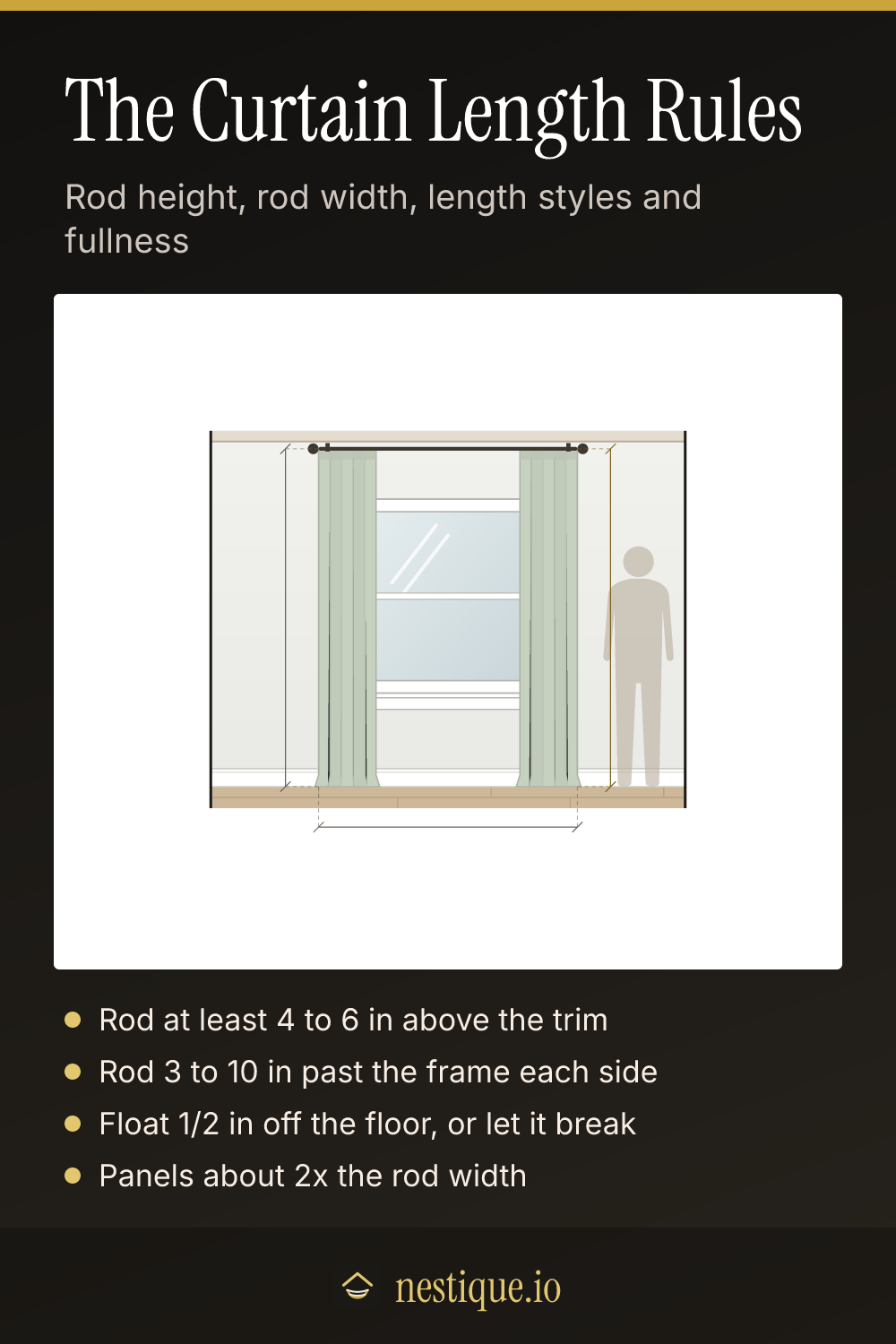
Hang the rod high. At minimum, the rod goes 4 to 6 inches above the window trim. Going higher, up to just under the ceiling or crown molding, makes the window and the room look taller. It is the single biggest change most rooms can make.
Hang it wide. Run the rod 3 to 10 inches past the trim on each side. When the curtains are open, the fabric stacks on the wall instead of over the glass, so you keep the light.
Pick a length on purpose. Sill length stops about 1/2 inch above the sill. Apron length covers the trim under the sill, about 4 inches lower. Floor length either floats 1/2 inch off the floor or just kisses it. A break adds 1 to 3 inches so the fabric folds on the floor. A puddle adds 6 to 8 inches. The one length to avoid is a few inches short of the floor, which looks like a mistake.
Buy enough width. The panels together should measure about 2 times the rod length when closed. 2.5 times looks full and soft. 1.5 times looks flat and tailored, which suits linen and blackout panels.
Buy ready-made, then adjust. Ready-made panels come in 63, 84, 95, 96, 108 and 120 inch lengths. When none matches exactly, either move the rod up or down a little, or hem. The calculator picks the smaller change.
Assumptions
Lengths are measured from the rod to the hem. For rod-pocket, back-tab and grommet panels that is the length on the label. For clip rings, the calculator takes off 1 1/2 inches for the ring and clip.
The rod sits no higher than 2 inches below the ceiling, to leave room for the brackets, and no lower than 4 inches above the trim. Floors are assumed level. Old houses often are not, so measure at both ends of the window and use the shorter number.
Ready-made widths are 42, 50 and 54 inches, plus extra-wide panels around 100 inches. Real panels can be an inch or so off their label, especially after washing.
Worked example
Say the window is 48 inches wide and 54 inches tall, its trim starts 26 inches off the floor, and the ceiling is 8 feet.
- High rod, floating length. The rod goes 2 inches under the ceiling, at 7 feet 10 inches. With 8 inches past the trim on each side it is 64 inches wide. The finished length is 93 1/2 inches. Buy 95 inch panels and hem them 1 1/2 inches, or let them break on the floor.
- Low rod instead. With the rod 5 inches above the trim, at 85 inches, 84 inch panels fit if the rod comes down another 1/2 inch.
- Puddled curtains. Puddling adds 6 inches, for 100 inches of fabric. 96 inch panels work with the rod 4 inches lower, at 7 feet 6 inches.
- Sill length. The curtain needs 67 1/2 inches, so 63 inch panels with the rod at 7 feet 5 1/2 inches.
For width, 2 times the 64 inch rod is 128 inches of fabric. Four 42 inch panels cover it. A single pair of 54 inch panels also works if you want a flatter look, at about 1.7 times fullness.
Pin it for later
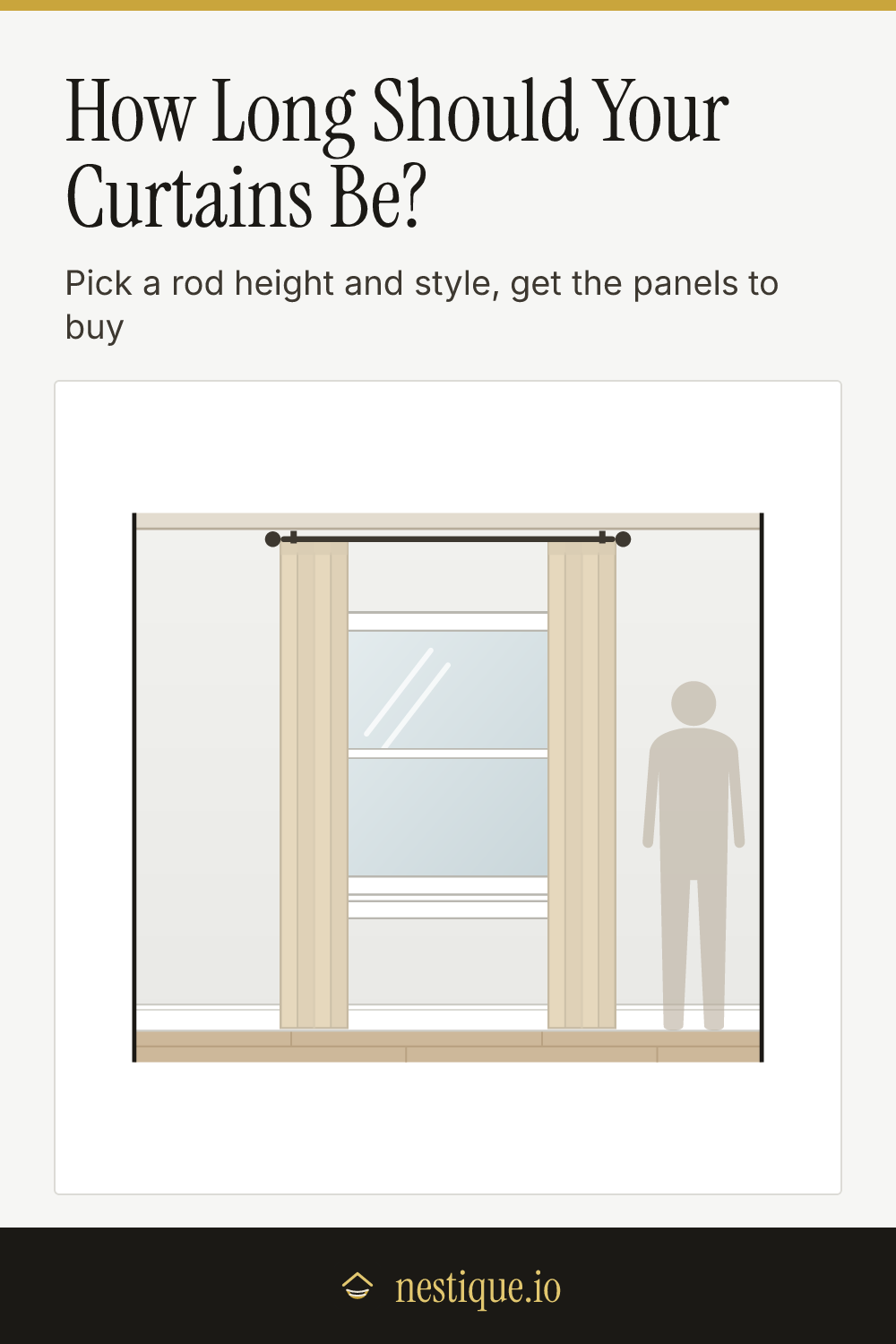
Curtain Length Calculator FAQ
How long should curtains be?
For most rooms, long enough to float about half an inch above the floor or just touch it. Sill-length curtains suit kitchens and windows over a radiator or bench. Curtains that break or puddle on the floor look relaxed and formal in turn, but they collect dust and get in the way of a vacuum.
How high should a curtain rod be above the window?
At least 4 to 6 inches above the window trim. Many designers go higher, halfway to the ceiling or just under it, because it makes the window and the ceiling look taller. Just make sure the panels you buy are long enough to reach the floor from there.
How wide should a curtain rod be?
Extend the rod 3 to 10 inches past the trim on each side. About 8 inches is a good default. Go wider if you want the open curtains to clear the glass completely, which lets in more light and makes the window look bigger.
Are curtains 84 or 96 inches more common?
Both are standard, along with 63, 95, 108 and 120 inch panels. With an 8 foot ceiling, 84 inch panels reach the floor only when the rod sits fairly low, about 84 inches up. Hang the rod higher and you need 95 or 96 inch panels.
How many curtain panels do I need?
Add up the panel widths and aim for about 2 times the length of the rod, or 2.5 times for full, heavily gathered curtains. A 64 inch rod needs about 128 inches of fabric, which is four 42 inch panels. A pair of 54 inch panels works too, with a flatter look.