How to use the mulch calculator
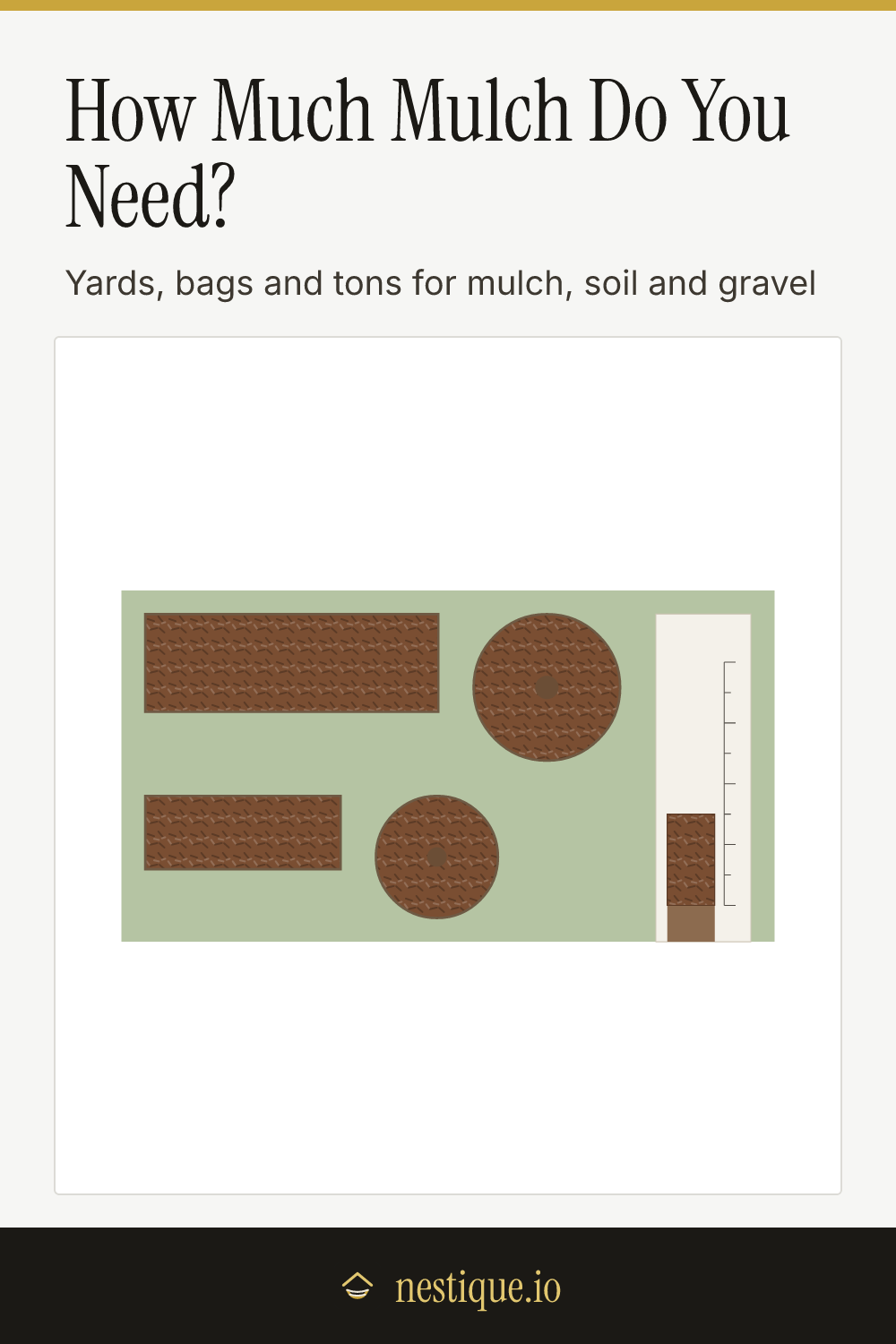
Start by picking the material at the top: wood mulch, compost, topsoil, pea gravel, river rock or crushed stone. The depth jumps to the recommended depth for that material, and the drawing fills with it.
Then enter your bed. Choose Rectangle or Circle. For a rectangle, measure the length and the width. For a circle, such as a ring around a tree, measure straight across the middle. Type sizes as 20’ or 20 ft 6 in, or tap the minus and plus buttons. The unit toggle switches to centimeters and gives the answer in cubic meters and liters.
Most yards have more than one bed. Tap + Add bed for each one, up to eight. The totals cover every bed, and the drawing shows them all to scale so you can spot a size you typed wrong. An odd-shaped bed can be split into a rectangle and a circle, or entered as the rectangle that roughly matches its area.
Set the depth if you want something other than the recommendation. The hint under the depth shows the usual range for the material you picked.
The result shows the volume, bag counts, the bulk order and the cost of each way to buy. Prices start at typical US figures. Change them to what your garden center or landscape supplier charges and the cheaper option is highlighted.
The rules behind the numbers
Volume is area times depth. Multiply the bed area in square feet by the depth in inches, then divide by 12 to get cubic feet. Divide cubic feet by 27 for cubic yards, which is how bulk material is sold. Round beds use pi times the radius squared for the area.
Depth depends on the material. University extension services recommend 2 to 4 inches of wood mulch, with 3 inches the usual target. Compost spread as a top dressing goes on 1 to 3 inches deep. Topsoil for a new bed or lawn goes on 4 to 6 inches deep. Decorative gravel and river rock look right at 2 to 3 inches, paths at 3 to 4 inches, and a gravel driveway needs 4 to 6 inches.
Bags are rounded up. Mulch, compost and soil are bagged in 2 and 3 cu ft sizes. Decorative stone usually comes in bags of about half a cubic foot. You cannot buy part of a bag, so the count always rounds up.
Stone is sold by weight. Landscape suppliers sell gravel by the ton. The calculator multiplies the cubic yards by a typical weight for each stone: about 1.4 tons per yard for pea gravel and crushed stone, and about 1.35 for river rock. Bulk orders round up to the next half yard, or the next half ton for stone.
Bulk wins on big jobs. Below about half a yard, bags are handy and easy to carry. Above a yard, bulk is almost always cheaper, even with a delivery fee.
Assumptions
Beds are treated as flat, so the depth is the same everywhere. Slopes and mounded beds use a little more. The volume is what you spread, with no allowance for settling. Fresh wood mulch and loose topsoil settle by 10 to 20% over the first weeks, and gravel on a path packs down, so add a little if you want the finished depth to match.
Stone weights are for dry material. Wet gravel and soil weigh more, so a delivery quoted by weight can cover slightly less ground after rain. Prices do not include delivery, landscape fabric or edging.
Worked example
Say you have a 20 by 4 foot bed along the house and want 3 inches of wood mulch.
- Area: 20 x 4 = 80 sq ft.
- Volume: 80 x 3 / 12 = 20 cu ft, which is 20 / 27 = 0.74 cu yd.
- Bags: 20 / 2 = 10 bags of 2 cu ft, or 20 / 3 = 6.7, so 7 bags of 3 cu ft.
- Bulk: 0.74 cu yd rounds up to 1 yard.
- Cost at typical prices: 10 small bags at $4 is $40, 7 large bags at $6 is $42, and a yard of bulk mulch is about $40 before delivery. For one bed, bags are the easy choice.
Add a 6 foot ring of mulch around a tree and the area grows by 28.3 sq ft, to about 108 sq ft. That is almost exactly one cubic yard at 3 inches, and the point where bulk starts to pay.
Pin it for later
Mulch, Soil & Gravel Calculator FAQ
How much area does a yard of mulch cover?
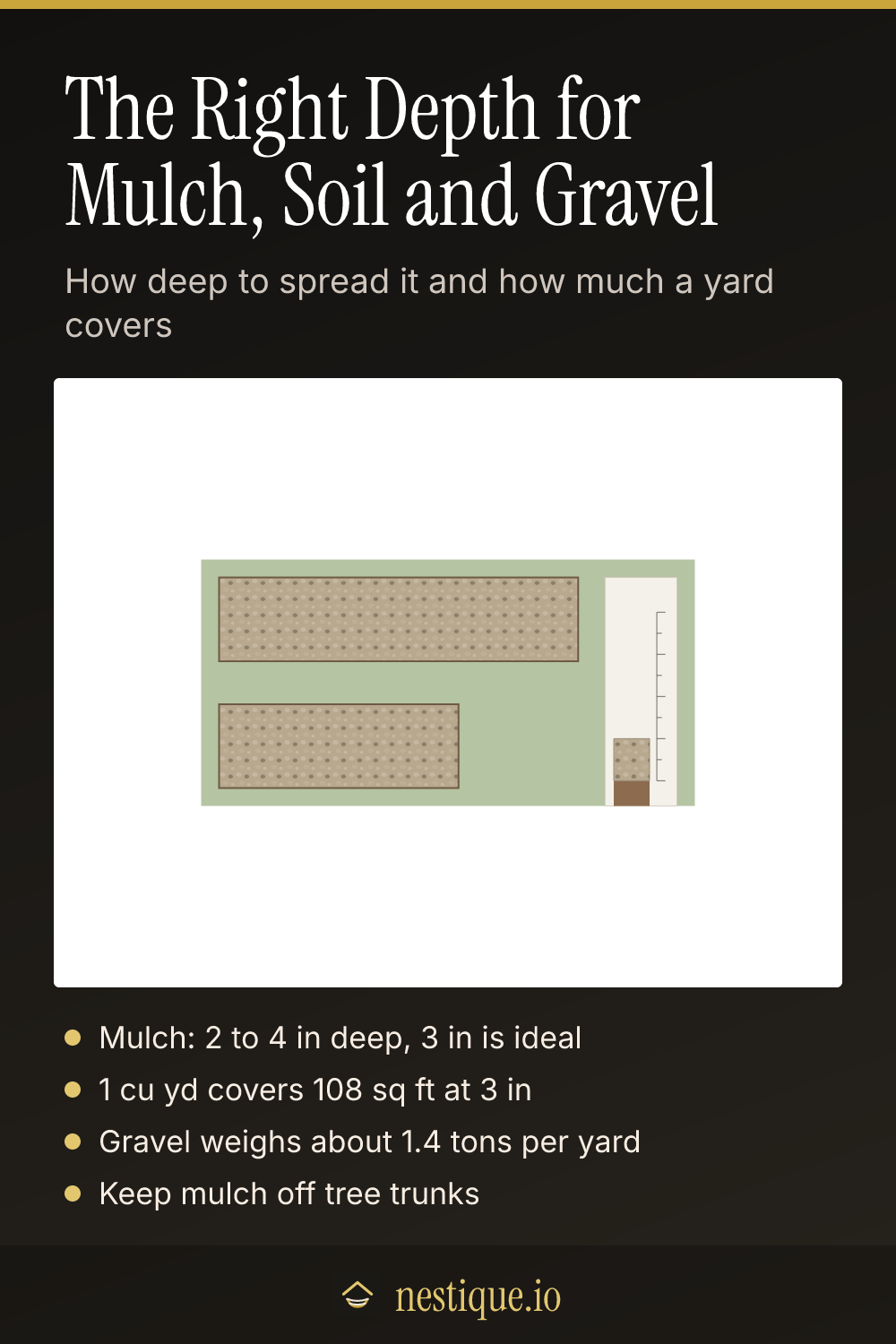
One cubic yard of mulch covers about 108 sq ft at 3 in deep, 162 sq ft at 2 in and 81 sq ft at 4 in. A cubic yard is 27 cu ft, so divide 324 by the depth in inches to get the square feet it covers.
How many bags of mulch are in a yard?
Thirteen and a half 2 cu ft bags, or nine 3 cu ft bags. Round up, so buy 14 of the 2 cu ft size. Once you need more than about a yard, bulk delivery is usually cheaper than bags, though most suppliers charge a delivery fee.
How deep should mulch be?
Two to 4 inches, with 3 inches the usual target. That is deep enough to keep weeds down and hold moisture without smothering roots. Keep mulch a few inches away from tree trunks and plant stems, and top it up by an inch or so each year as it breaks down.
How many tons of gravel do I need?
Work out the cubic yards, then multiply by the weight of the stone. Pea gravel and crushed stone weigh about 1.4 tons per cubic yard and river rock about 1.35. A 10 x 10 ft path 3 in deep is about 0.93 cu yd, or roughly 1.3 tons of pea gravel.
How much topsoil do I need for a new bed?
Plan on 4 to 6 inches for a new bed or a new lawn. A 10 x 4 ft bed at 4 inches needs 13.3 cu ft, about half a yard, which is seven 2 cu ft bags or five 3 cu ft bags.