How to use the deck board calculator
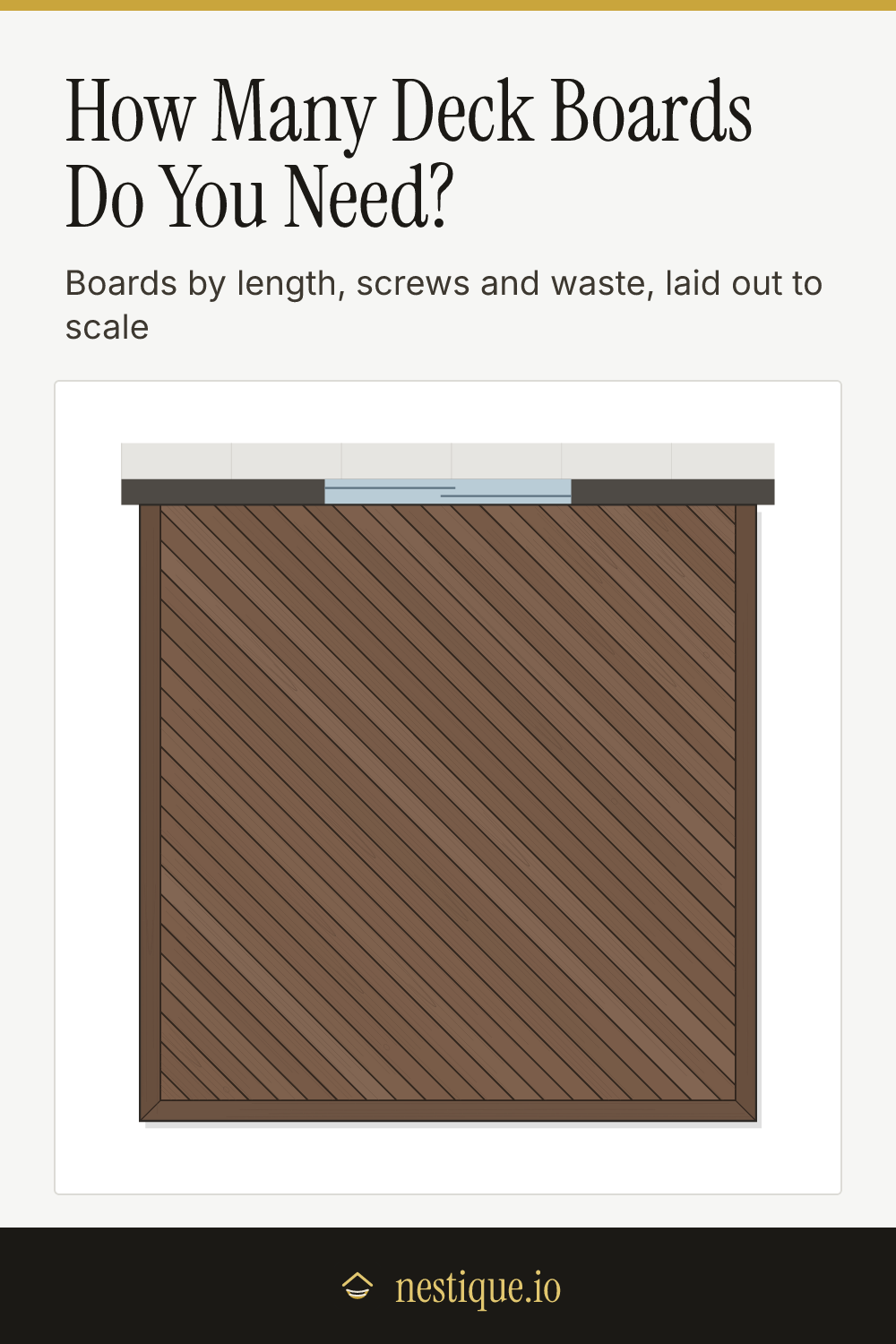
Start with the board direction at the top. Straight runs the boards along the house, across the joists. Diagonal 45° turns them to a 45 degree angle, which looks great but needs closer joists and more boards.
Then enter the deck size. Length is the side along the house and width is how far the deck sticks out from it. Type feet and inches (16’ or 16’ 6”) or tap the minus and plus buttons. Switch to centimeters with the unit toggle if you work in metric.
Next, set up the boards:
- Decking: 5/4 x 6 wood, 2 x 6 wood, 2 x 4 wood, standard composite or wide composite. The hint under the buttons shows the real width of the board.
- Board length: leave it on Auto and the calculator picks the stock length that wastes least for each piece. Pick one length if your yard only stocks that size, or if you want a simple order.
- Gap: 1/8 inch suits dry wood. Composite usually wants 3/16 inch.
- Joist spacing: the distance between joist centers. If your boards can’t span it, the result turns red and offers the spacing they need.
- Picture-frame border: adds a border board along the three open sides, mitered at the corners.
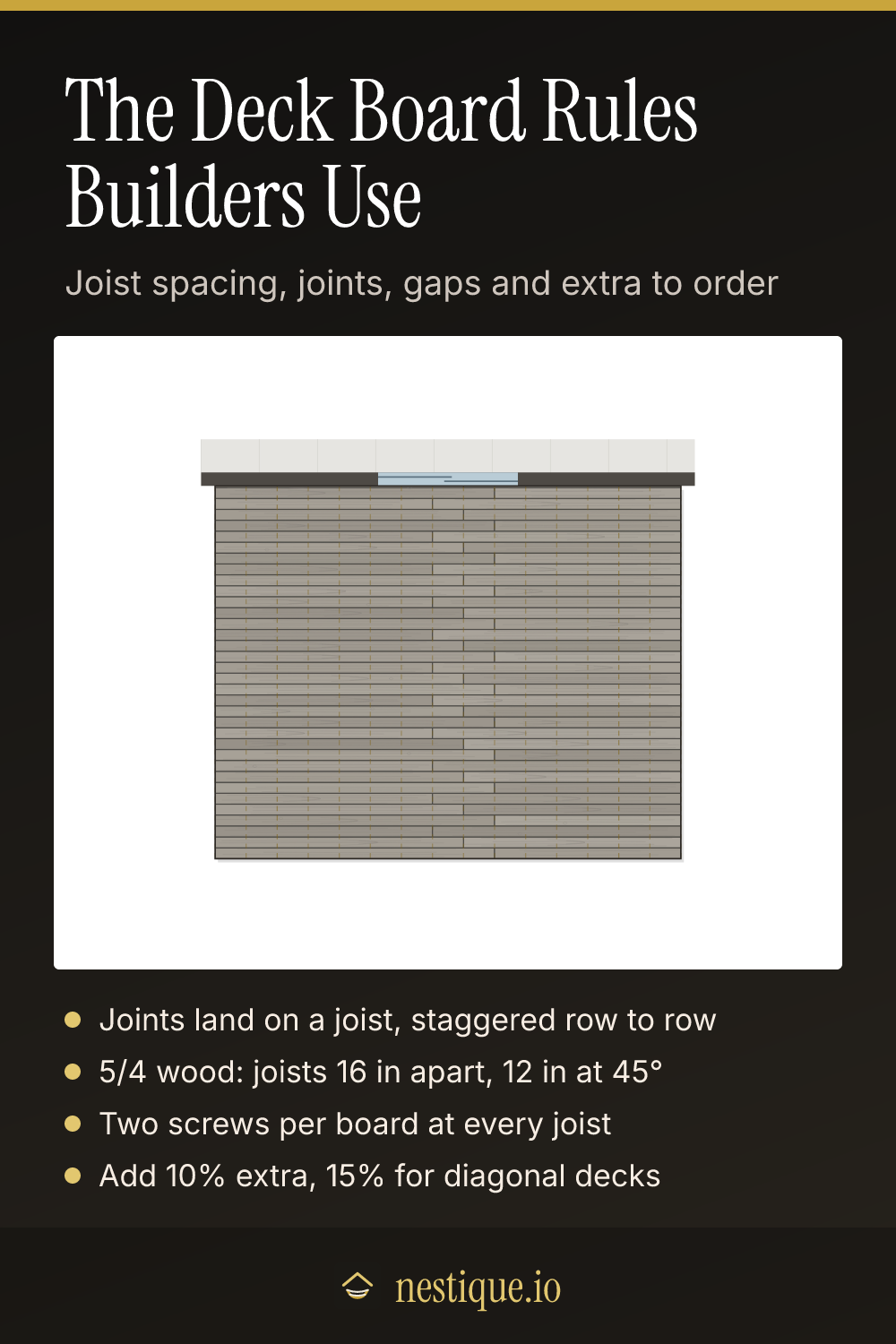
The drawing shows every board to scale, with the joists as dashed lines. Where a row needs more than one board, you can see each joint sitting on a joist and moving over from row to row. Below it you get the boards to order at each length, the rows, the linear feet, the screws or hidden clips, and anything worth checking. Save it as an image to take to the lumberyard.
The rules behind the board count
Rows come from the board width plus one gap. A 5/4 x 6 board is really 5 1/2 inches wide. Add a 1/8 inch gap and each row takes 5 5/8 inches. The calculator starts with a full board at the outside edge and works back to the house, so any ripped board ends up against the wall where it is least noticed.
Every joint lands on a joist. Two boards that meet in a row butt together over a joist so both ends are screwed down. Joints move over at least one joist from one row to the next. Lined-up joints make a weak, obvious seam across the deck. No piece is shorter than two joist spaces, so every board bears on at least three joists.
Joist spacing depends on the board and the angle. The common limits, from the deck section of the residential building code, are 16 inches on center for 5/4 wood laid straight and 12 inches at 45 degrees. Full 2 inch thick boards can span 24 inches straight and 16 inches at 45 degrees. Composite boards follow the maker’s label, and most standard composite reads 16 inches straight and 12 inches diagonal.
Diagonal boards need more wood. At 45 degrees each board is cut at an angle on both ends, and the rows near the corners are short. Plan on about 15% extra rather than 10%.
Two screws per board at every joist. Face screws go in pairs, about 3/4 inch in from each edge. Hidden clips sit in the grooves between boards, about one per board at each joist.
Assumptions
The deck is a rectangle with joists running out from the house, spaced from one end, with rim joists at both ends. The boards end flush with the deck edge. If you plan to overhang the rim by an inch or so, add that to the length and width you enter.
Board widths are standard actual sizes: 5 1/2 inches for 6 inch boards and composite, 3 1/2 inches for 2 x 4s and 7 1/4 inches for wide composite. Stock lengths are 8 to 20 feet for wood and 12, 16 and 20 feet for composite. Leftover pieces of 2 feet or longer are reused in later rows, which is how most builders work.
The picture-frame border runs along the front and both ends. It needs a doubled joist under each side board and blocking under the front one. Stairs, cut corners and posts that boards notch around are not modeled, so add a few boards if your deck has them. Screw and clip counts are estimates rounded up to the nearest ten. Check the fastener box for how many it holds.
Worked example
Say the deck is 16 feet along the house and 12 feet deep, with 5/4 x 6 wood boards, 1/8 inch gaps and joists 16 inches apart.
- Rows: 12 feet is 144 inches. Each row takes 5 5/8 inches, so 26 rows cover it. The last row against the house is ripped to 3 3/8 inches.
- Boards per row: the deck is exactly 16 feet long, so each row is one 16 ft board with no joints at all.
- Boards to order: 26 boards, plus 10% extra, rounded up, is 29 boards at 16 ft. That is 416 linear feet in the cut list.
- Screws: each board crosses 13 joists, so 26 screws a board and about 680 for the deck.
Turn the same deck to 45 degrees and the joists must move to 12 inches apart. The diagonal rows vary from a few inches to about 17 feet long, so the order becomes a mix of lengths: 42 boards and 429 linear feet with 15% extra.
Stretch the straight deck to 22 feet long and no single board covers a row. Each row now takes two boards with the joint on a joist, and the order rises to 58 boards across five lengths.
Pin it for later
Deck Board Calculator FAQ
How many deck boards do I need for a 12 x 16 deck?
With 5/4 x 6 boards running the 16 ft way and 1/8 inch gaps, a 12 x 16 ft deck takes 26 rows of 16 ft boards. Add 10% for split ends and miscuts and you order 29 boards. Narrower 2 x 4 boards or a diagonal layout need more.
How do you calculate deck boards?
Divide the deck width by the board width plus one gap to get the number of rows, rounding up. Then work out how many boards each row needs, with every joint landing on a joist. Total the boards by length and add 10% extra, or 15% if the boards run diagonally.
How far apart should deck joists be?
For 5/4 wood decking and most composite boards, 16 inches on center when the boards run straight across the joists, and 12 inches when they run at 45 degrees. Full 2 inch thick wood boards can span 24 inches straight and 16 inches diagonally. Always check the label on composite boards.
How many screws do I need per deck board?
Two screws per board at every joist it crosses. A 16 ft board on joists 16 inches apart crosses 13 joists, so it takes 26 screws. Hidden fasteners work out to about one clip per board at each joist.
How much waste should I add for decking?
Add about 10% for a straight deck and 15% for a diagonal one. The cut list already counts the offcuts from fitting boards to the deck; the extra covers split ends, warped boards and the odd miscut.