How to use the concrete calculator
Pick what you are pouring at the top: a slab, a footing, post holes or steps. Each one asks for different measurements, and the drawing changes to match so you can check you entered what you meant.
- Slab: the length and width of the area, and the thickness. Use this for patios, walkways, shed floors, pads for air conditioners and driveways.
- Footing: the total length of footing (add every run together), plus its width and depth. This is the strip of concrete a foundation wall or a garden wall sits on.
- Post holes: the hole or forming tube diameter, the depth and how many holes. Use it for deck piers, fence posts and mailbox posts.
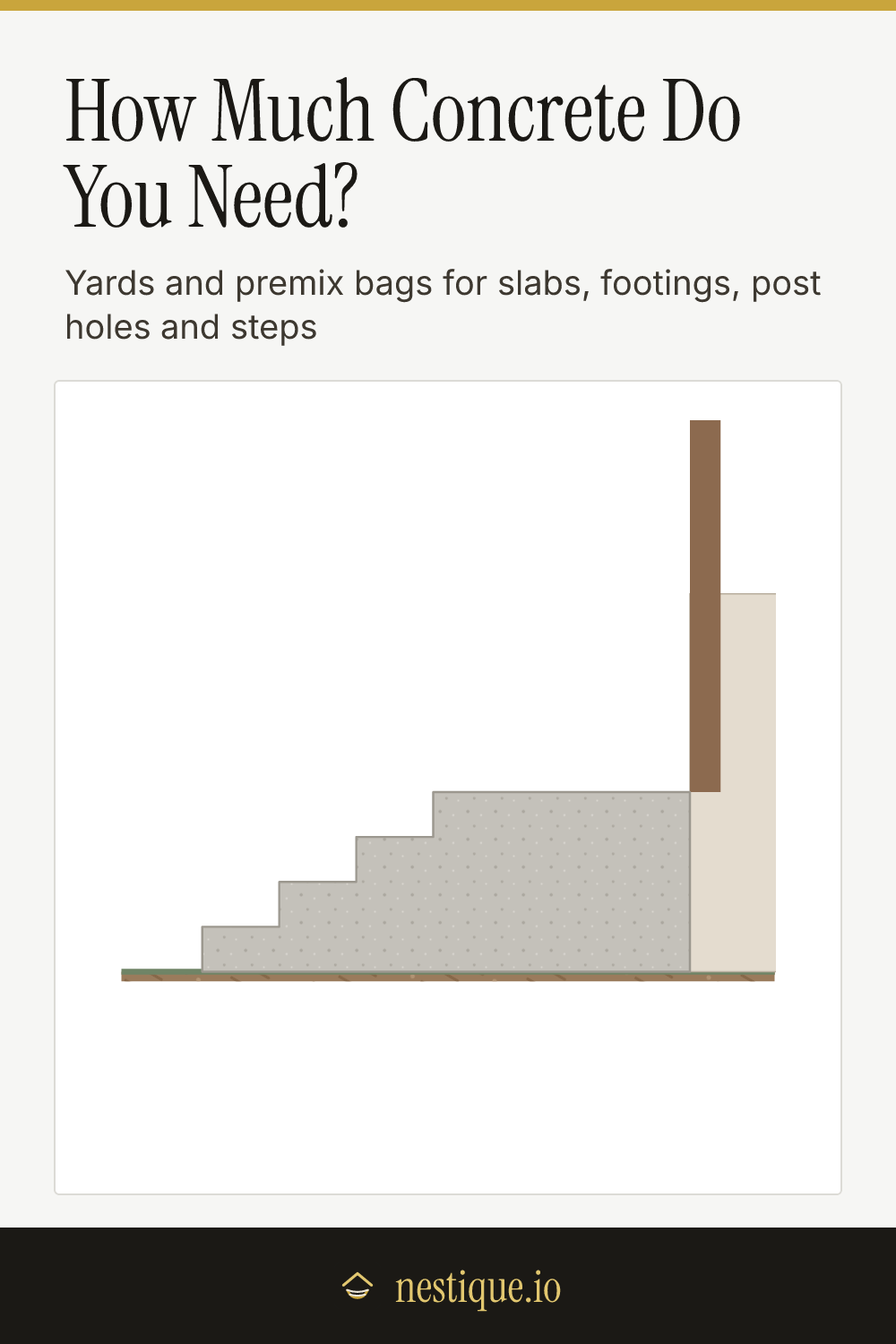
- Steps: how many steps, how wide they are, the rise of each step, the tread depth and the depth of the top landing by the door.
Type sizes as 12’ 6” or 12.5, or tap the minus and plus buttons. The unit toggle switches to centimeters and gives the answer in cubic meters and liters.
Then choose how much extra to order and which premix bag size you plan to buy. The result shows the volume, the number of bags in all three sizes, the ready-mix order in quarter yards, and what each option costs. The prices are typical US figures. Change them to what your store or supplier charges and the cheaper option is highlighted.
The rules behind the numbers
Volume is length times width times depth. Everything is converted to inches, multiplied, and divided by 1,728 to get cubic feet. Divide by 27 for cubic yards, which is how ready-mix is sold.
Round holes use the circle formula. A hole’s volume is pi times the radius squared times the depth. A 10 in hole 42 in deep holds about 1.9 cu ft.
Steps are stacked blocks. The bottom step is one rise tall and one tread deep, the next is two rises tall, and so on. The top step is the landing, so it uses the landing depth instead of the tread depth. The calculator treats steps as solid concrete, which is how most small porch steps are poured.
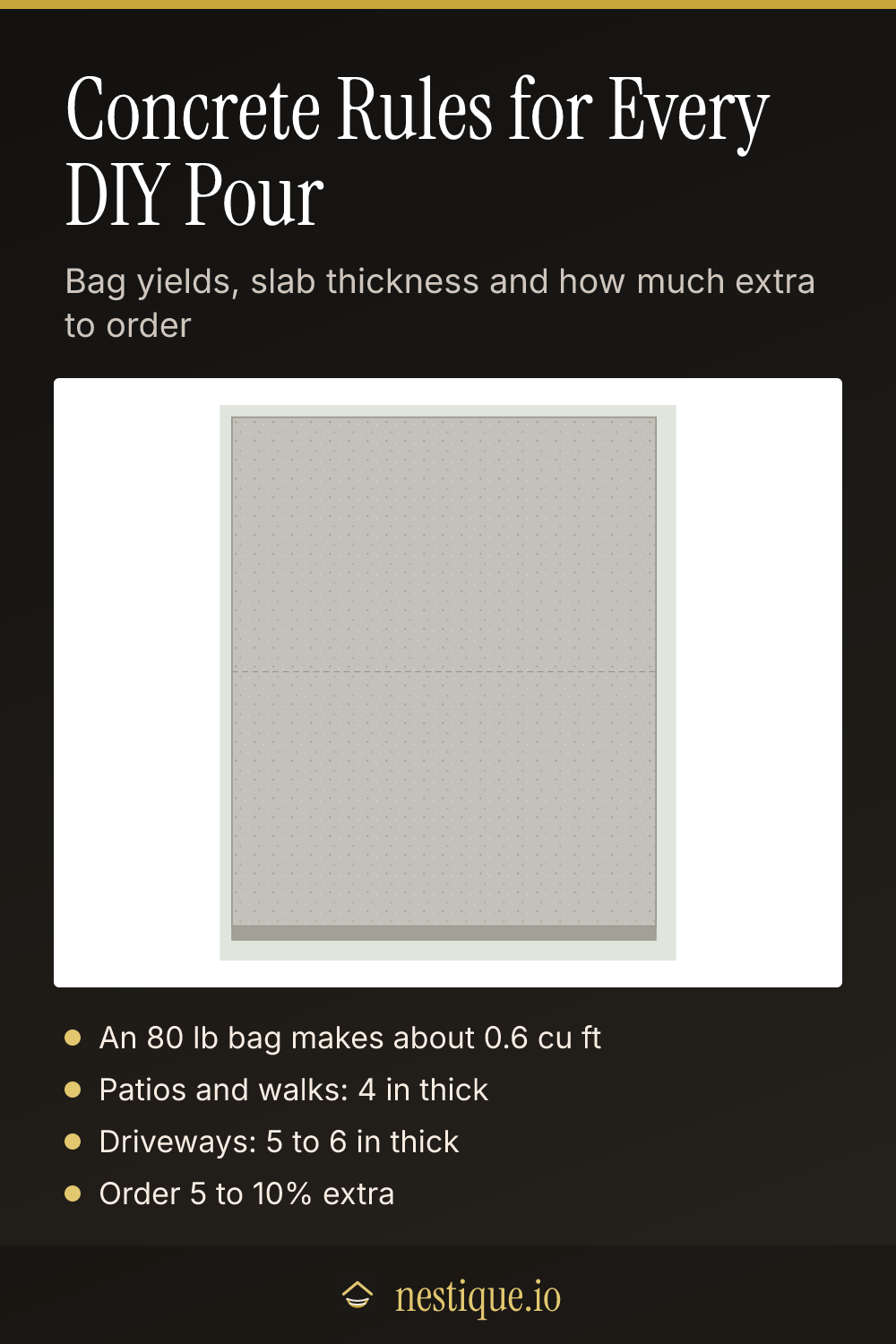
Bag yields come from the bag. An 80 lb bag of premix makes about 0.6 cu ft, a 60 lb bag about 0.45 cu ft and a 40 lb bag about 0.3 cu ft. The count is always rounded up to whole bags.
Order extra. The default is 10%, which covers uneven ground, forms that bow out and what sticks to the tools. Use 5% for a carefully formed, well-graded pour and 15% for rough ground.
Thickness matters. Building codes ask for at least 3 1/2 in for a slab on the ground. Four inches is normal for patios and walks, and 5 to 6 in for driveways. Continuous footings need to be at least 12 in wide and 6 in thick, and often more, depending on the soil and the load.
Bags or a truck. Up to about one cubic yard, bags are practical. Above that, mixing by hand gets slow and the first batches start to set before you finish, so ready-mix is usually the better buy.
Assumptions
The calculator works out the volume of the shape you enter and adds the waste you choose. It does not allow for gravel base, rebar or wire mesh, which take up a tiny amount of space and are normally ignored. Holes are treated as straight cylinders. A hole dug wider at the bottom, or a bell-shaped footing, holds more.
Ready-mix is rounded up to the next quarter yard. Prices do not include delivery, short-load fees, pump hire, forms, rebar or tools. Frost depth, footing size and slab thickness for structural work are set by your local building code, not by this tool.
Worked example
Say you are pouring a 12 by 10 foot patio, 4 inches thick, and you want 10% extra.
- Volume: 144 in x 120 in x 4 in = 69,120 cubic inches, which is 40 cu ft or 1.48 cu yd.
- With 10% extra: 44 cu ft, or 1.63 cu yd.
- Bags: 44 / 0.6 = 73.3, so 74 bags of 80 lb premix. In 60 lb bags it is 98, and in 40 lb bags 147.
- Ready-mix: 1.63 cu yd rounds up to 1.75 cu yd.
- Cost at typical prices: 74 bags at $6.50 is about $481. Ready-mix at $175 a yard is about $306 before delivery, and it saves an afternoon of mixing.
Pin it for later
Concrete Calculator FAQ
How many bags of concrete do I need for a 10 x 10 slab?
A 10 x 10 ft slab 4 in thick holds 33.3 cu ft, about 1.23 cu yd. With 10% extra that is 36.7 cu ft, so you need 62 bags of 80 lb premix (0.6 cu ft each), 82 bags of 60 lb or 123 bags of 40 lb. At that size a ready-mix truck is usually the easier choice.
How much does an 80 lb bag of concrete make?
About 0.6 cu ft once mixed. A 60 lb bag makes about 0.45 cu ft and a 40 lb bag about 0.3 cu ft. It takes 45 bags of 80 lb premix to make one cubic yard, before any waste.
How thick should a concrete patio be?
Four inches is the standard for patios, walkways and shed floors. Building codes set 3 1/2 in as the minimum for a slab on the ground. Driveways and slabs that carry vehicles or a hot tub are usually poured 5 to 6 in thick.
When should I order ready-mix instead of bags?
Above about one cubic yard. That is 45 or more 80 lb bags, which is a lot of mixing, and the first batches start to set before the last ones go in. Ready-mix suppliers often add a short-load fee for small orders, so get a quote for your exact volume.
How much extra concrete should I order?
Five to 10% on top of the measured volume. Ground is never perfectly flat, forms bulge a little and some concrete stays in the wheelbarrow. Running short in the middle of a pour leaves a cold joint, so it is cheaper to have a little left over.