How to use the fence visualizer
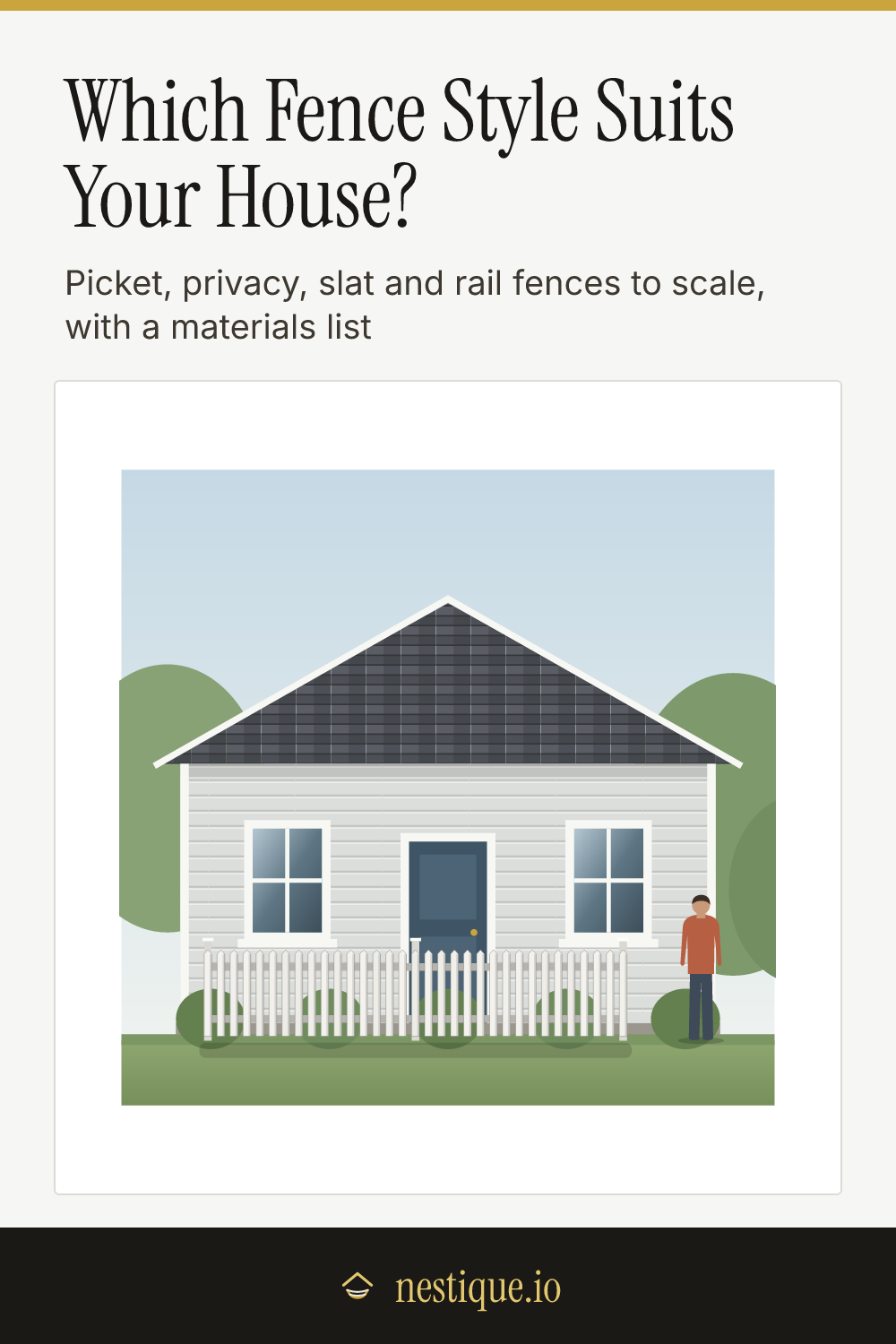
Pick a style from the pictures at the top: picket, horizontal slat, privacy, lattice top, split rail or modern mix. Each one opens at the height, board size and gap it is most often built with, so the drawing looks right straight away.
The drawing is a scaled front view. The fence stands in front of a house, and the figure beside it is 5 ft 7 in tall, so you can see how much of a person a 4 ft or a 6 ft fence hides. Up to three sections are shown, with the height and the post spacing marked.
Then set it up for your yard:
- Height: 3 to 8 ft, in 6 inch steps.
- Run length: the total length of fence you need. Measure each straight run and add them up.
- Posts up to: the widest post spacing you want. The posts are spread evenly, so the result tells you the real spacing.
- Board width and gap: the picket, board or slat width and the space between them. Privacy fences can switch to board-on-board.
- Color: natural and stained wood or a paint color. The modern style also lets you pick the metal posts and frame.
The result lists what to buy for your run: posts with their length and depth, bags of concrete, rails, pickets or slats, lattice, center supports, top caps and fasteners. You also get a privacy rating based on how much of the fence you can see through, and notes on height limits and pool rules. Save the drawing as an image to compare styles side by side or share with a neighbor.
The rules behind the materials list
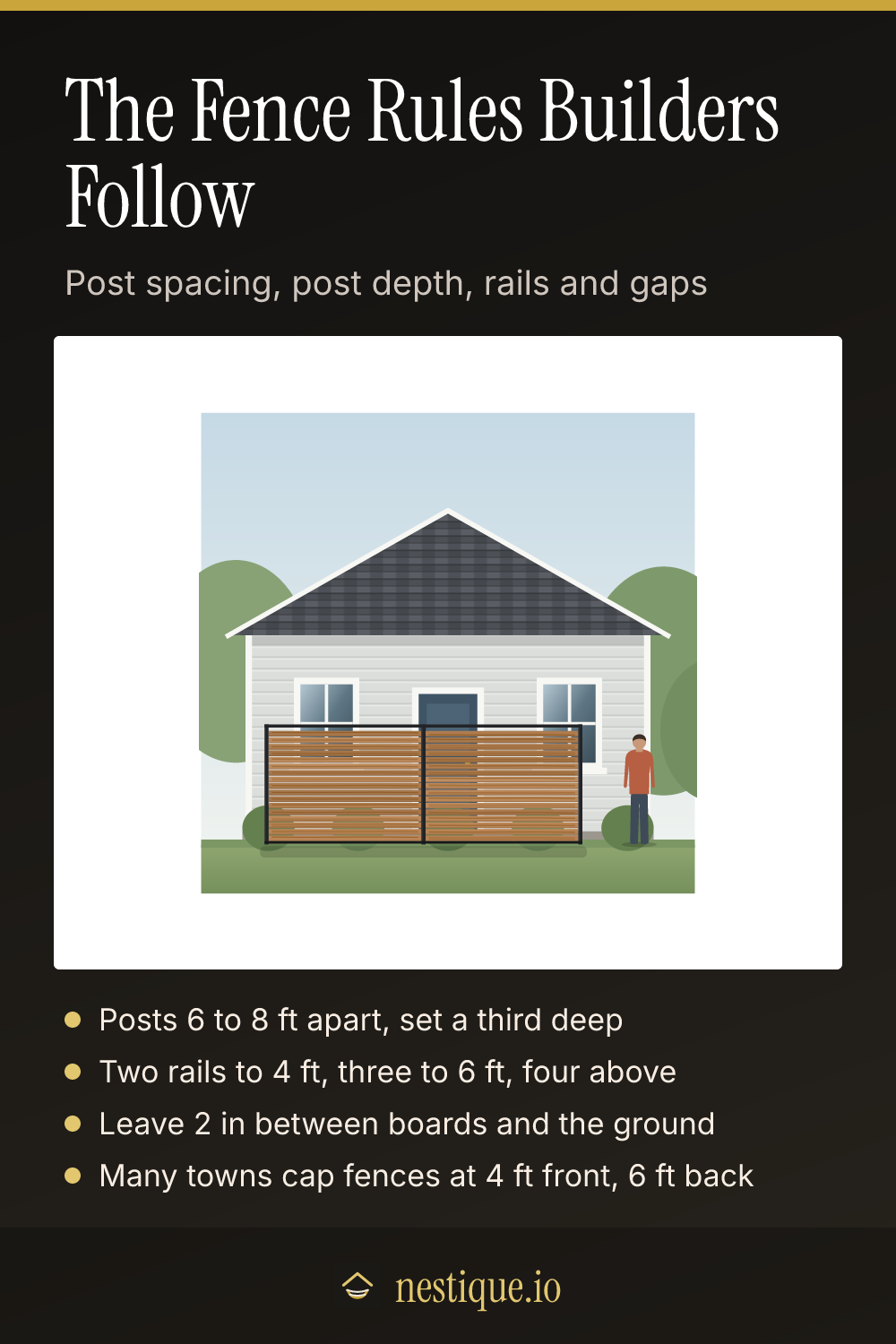
Posts every 6 to 8 feet. Eight feet is the usual spacing because rails and boards come in 8 ft lengths. The visualizer divides your run into equal sections no longer than the spacing you choose and adds one post at the end.
Bury a third of the height. Posts go into the ground about a third of the fence height, and never less than 2 feet. A 4 ft fence takes 6 ft posts and a 6 ft fence takes 8 ft posts. Where the ground freezes, dig below the frost line. Fences over 6 ft get 6x6 posts because they catch more wind.
More rails as the fence gets taller. Vertical boards hang on horizontal 2x4 rails: two rails up to about 4 ft, three up to 6 ft and four above that. A lattice-top fence gets one more rail for the lattice to sit on. Split-rail fences use two rails at about 3 ft and three at 4 ft.
Keep boards off the soil. Boards stop about 2 inches above the ground so they don’t wick up water and rot.
Concrete for each post. Holes are about three times the post width, so 10 inches across for a 4x4. A 4x4 set 2 ft deep takes about three 50 lb bags of concrete mix.
Horizontal slats need support. Slats longer than about 6 ft sag over time, so sections wider than that get a center stud.
Gaps and pools. If your fence is a pool barrier, openings usually have to be small enough that a 4 inch ball cannot pass. Most picket gaps of 2 to 3 inches pass that test; split rail does not.
Assumptions
The fence is one straight run on level ground, with a post at each end and posts spaced evenly between. Corners, gates and slopes are not modeled. Add a post at each corner and a heavier post on each side of a gate, and count gate hardware separately.
Pickets and boards are face-nailed to the rails and run edge to edge along the whole run. Horizontal slats run post to post. Board lengths round up to common stock: 3, 4, 5, 6 and 8 ft for boards and 6 to 12 ft for posts. Rails come from 8, 12 or 16 ft boards, whichever cuts with the least left over.
Concrete counts assume a hole three times the post width, filled to ground level, with no gravel deducted. Fastener counts are rounded up to the nearest 50. The see-through share is worked out from the board and gap widths, and lattice counts as roughly half open. Real privacy also depends on your viewing angle and the slope of your yard.
Worked example
Say you want 100 feet of picket fence along the front of a yard, 3 ft 6 in tall, with 3 1/2 inch pickets and 2 1/2 inch gaps, and posts no more than 8 ft apart.
- Sections and posts: 100 ft divided into sections of 8 ft or less makes 13 sections of 7 ft 8 in, so you need 14 posts.
- Post length: a third of 3 ft 6 in is under 2 ft, so the posts go the minimum 2 ft deep. That needs 6 ft 4x4 posts.
- Concrete: three 50 lb bags per post, 42 bags in all.
- Rails: a fence this low needs two rails per section, 26 rails cut from 8 ft 2x4s.
- Pickets: each picket plus its gap takes 6 inches, so 201 pickets cover the run. They are 3 ft 4 in long after the 2 inch ground gap, so buy 4 ft pickets.
Switch the same run to a 6 ft privacy fence with 5 1/2 inch boards butted tight and the list changes: 219 boards 6 ft long, three rails per section for 39 in all, and 8 ft posts set 2 ft deep. Turn on board-on-board and the board count climbs to 284.
Pin it for later
Fence Visualizer FAQ
How far apart should fence posts be?
Six to eight feet on center. Eight feet is the most common because rails and boards come in 8 ft lengths, but closer posts make a stiffer fence in windy spots or soft ground. The visualizer spreads the posts evenly along your run so no section is longer than the spacing you pick.
How deep should fence posts be set?
About a third of the fence height, and never less than 2 feet. A 6 ft fence needs posts about 2 ft deep and an 8 ft fence closer to 3 ft. Where the ground freezes, go below the frost line so the posts do not heave.
How much space should be between fence pickets?
Most picket fences use gaps of 2 to 3 inches, a little less than the picket width. If the fence has to work as a pool barrier, local codes usually require openings smaller than 4 inches. Privacy fences butt the boards tight or use board-on-board.
What is a board-on-board fence?
Two staggered layers of boards. The back layer has gaps, and the front boards cover each gap with an inch or so of overlap. With 1 1/4 inch overlaps and 6 inch boards it takes about 30% more boards than a single layer, but it stays private when the boards shrink and looks the same from both sides.
How tall can a fence be?
It depends on your town. Many limit front-yard fences to about 4 ft and backyard fences to 6 ft, and anything taller needs a permit or a variance. Check your local rules and any homeowners association before you buy materials.