How to use the tile calculator
Pick the pattern first, at the top. The pattern sets how much extra tile you need, because some layouts cut far more tiles than others. Herringbone only appears for rectangular tiles, since square tiles can’t make it.
Then measure the area. For a floor, measure wall to wall in both directions. For a wall or a backsplash, measure the width and the height you plan to tile. Type the sizes as feet and inches (10’ 6”) or as a decimal (10.5), or tap the minus and plus buttons. Use the unit toggle for centimeters and square meters.
Tiling more than one space? Tap + Add area for each one: a hallway and a bathroom, or a floor and a shower wall that use the same tile. An L-shaped room works the same way. Split it into two rectangles and enter each as its own area. The totals cover every area, and the drawing shows the one you are editing.
Next, choose the tile size. The common sizes are listed. Tap Other to enter any size. Set the grout joint, then type the box size from the product label. Boxes are sold by the square foot, so that number is printed on every carton and product page.
Last, if you know the price, enter it per square foot or per box. The calculator prices the whole boxes you have to buy, not just the area, because that is what you pay for.
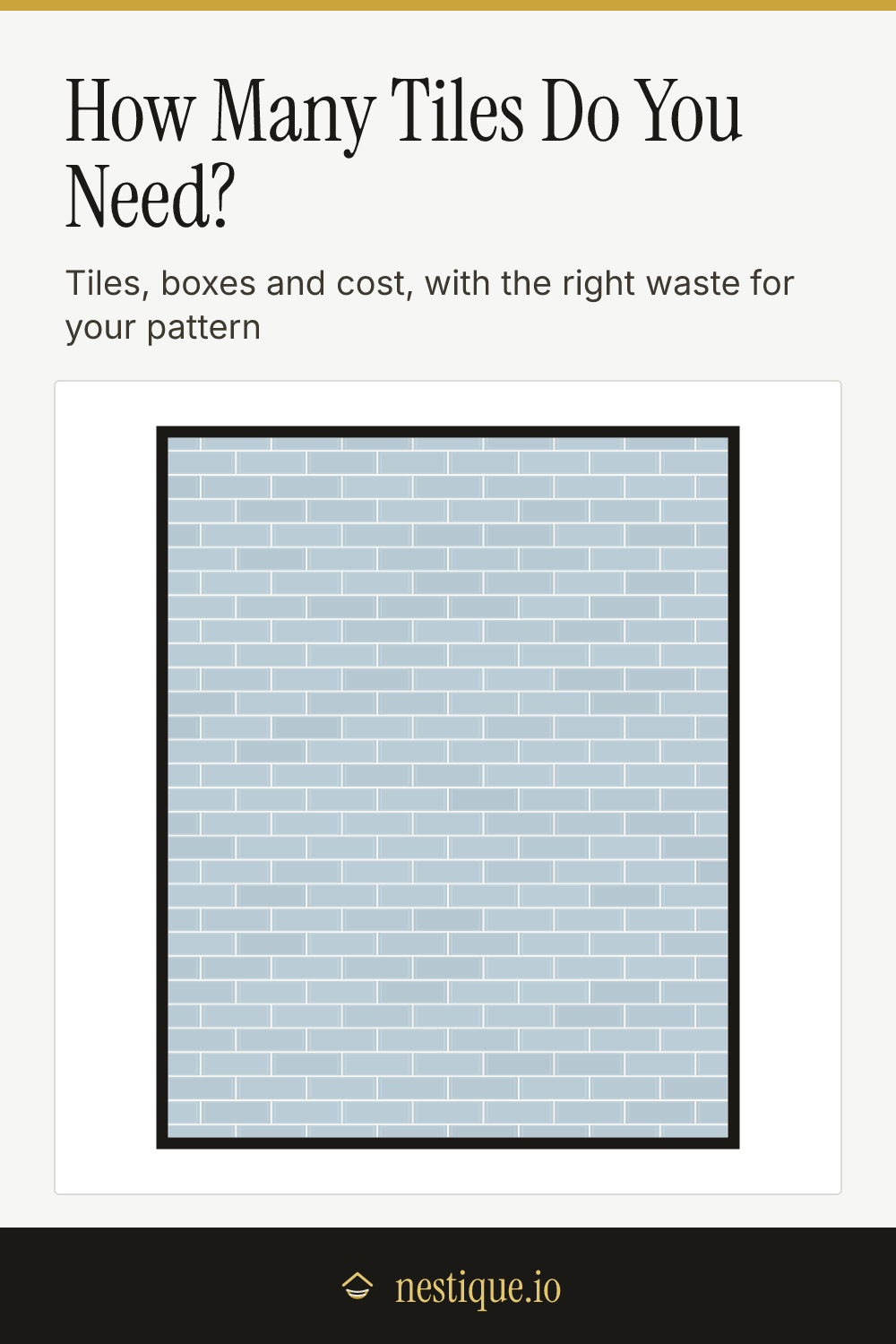
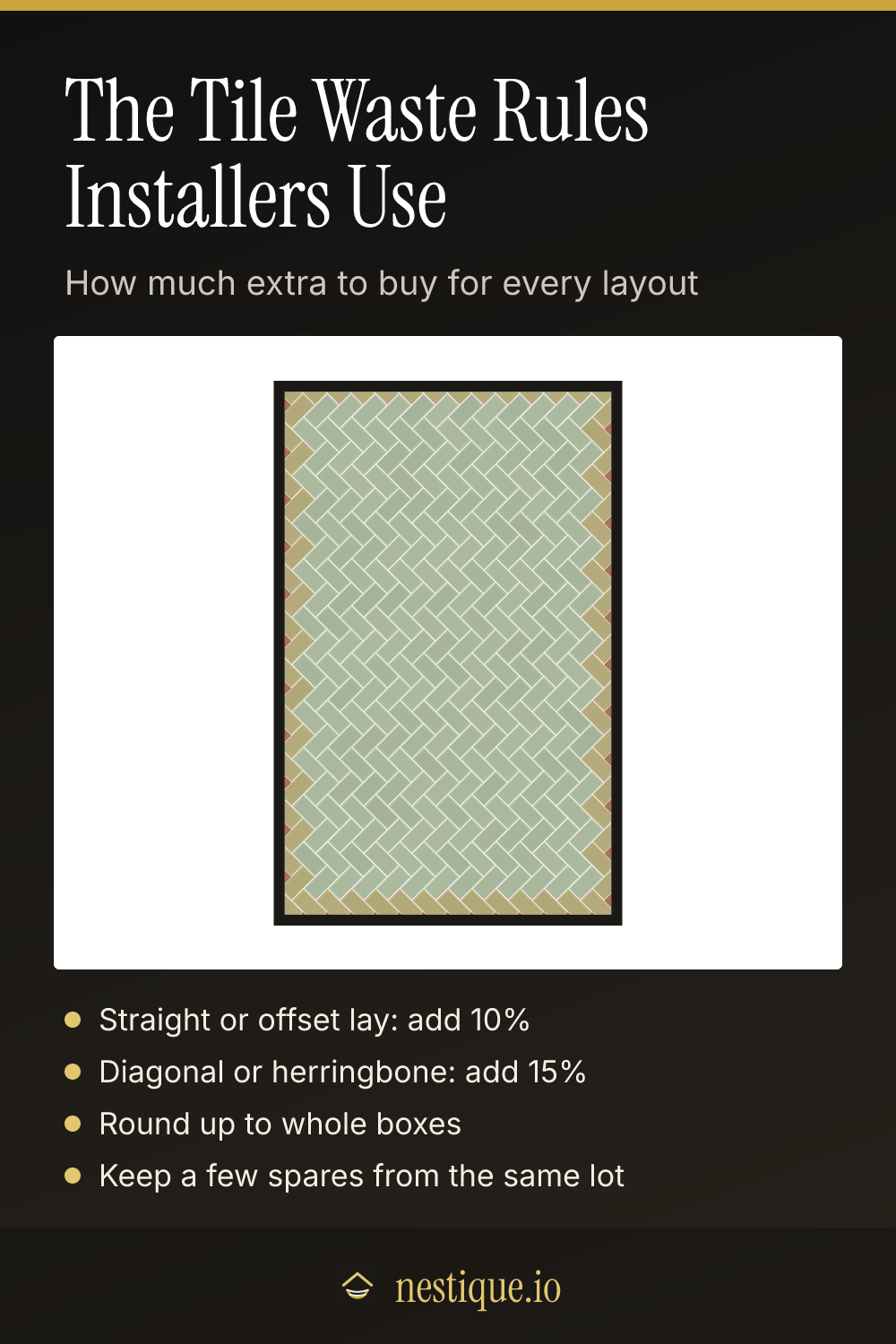
The drawing lays your tile on the area to scale, centered so the cuts at opposite walls match. Cut tiles are tinted, and slivers (cuts too thin to set well) are marked in red. Save the image to bring to the tile store.
The rules behind the numbers
Start with the area. Width times length gives the square footage. A 10 by 12 foot floor is 120 sq ft.
Add waste for the pattern. Every layout loses tile to cuts at the walls, plus a few breakages. Installers add:
- 10% for a straight grid or an offset (brick) layout.
- 15% for a diagonal layout, where every edge tile is cut on an angle.
- 15% for herringbone, where the pieces meet the walls at 45 degrees.
Count tiles by their face. One 12 by 12 inch tile covers 1 sq ft. A 12 by 24 inch tile covers 2 sq ft. Divide the area plus waste by the area of one tile and round up. Grout joints add a little coverage on top, which ends up as spare tile.
Round up to whole boxes. The tiles per box come from the box size on the label. Divide the tiles by the tiles per box and round up. You can’t buy part of a box, so the last one always leaves some extra.
Order it all at once. Tile is made in lots, and color can shift a little between them. Buy the whole job from one lot, and keep the spares for repairs.
Assumptions
Each area is a rectangle. Cabinets, tubs and islands are not subtracted. Most people tile under a freestanding tub and skip the space under built-in cabinets, so subtract that area yourself if you like. The calculator ignores grout when counting tiles, which keeps the count on the safe side.
The waste allowances are the usual single figures installers quote. Rooms with many corners, pipes or a floor vent need a little more. Very large tiles in a small room can waste much more, because nearly every tile gets cut, and the calculator warns you when an area is less than two tiles wide.
Long tiles in an offset layout are drawn at a one-third offset, which is the limit tile standards set for tiles over 18 inches long. Prices are whatever you type. No prices are built in.
Worked example
Say you are tiling a 10 by 12 foot kitchen floor with 12 x 12 inch tile in a straight grid. The tile comes 10 sq ft to a box and costs $3.50 per sq ft.
- Area: 10 x 12 = 120 sq ft.
- Waste: a straight grid takes 10%, so order 132 sq ft.
- Tiles: each tile covers 1 sq ft, so 132 tiles.
- Boxes: 10 tiles per box means 13.2 boxes, so 14 boxes, which hold 140 sq ft.
- Cost: 140 sq ft x $3.50 = $490, or about $4.08 for every square foot of floor.
Switch to 12 x 24 inch tile in an offset layout, at 16 sq ft per box. Waste is still 10%, so you still order 132 sq ft. Each tile covers 2 sq ft, so that is 66 tiles. Eight tiles fill a box, so you need 9 boxes.
Pin it for later
Tile Calculator FAQ
How do I calculate how many tiles I need?
Multiply the length by the width of the area to get square feet, then add a waste allowance: 10% for a straight or offset layout, 15% for diagonal or herringbone. Divide by the area of one tile (a 12 x 12 in tile is 1 sq ft) and round up. Then divide by the tiles per box and round up again.
How much extra tile should I buy?
Buy 10% extra for a straight or brick layout and 15% for diagonal or herringbone, where every edge tile is cut on an angle. Small rooms with lots of corners need a little more. Keep the leftovers: a few spare tiles from the same lot make a cracked-tile repair easy years later.
How many boxes of tile do I need for 100 square feet?
With 10% waste you need 110 sq ft of tile. Boxes usually hold 8 to 16 sq ft, so at 10 sq ft per box that is 11 boxes. Always round up to a whole box, and check the label, because box sizes vary by tile.
Does grout reduce the number of tiles needed?
Slightly. Each grout joint adds a sliver of coverage, so a 1/8 in joint on 12 in tile covers about 2% more area. Most estimators ignore it and so does this calculator. That little bit stays in the box as spare tile.
Should tile be ordered all at once?
Yes. Tile is made in batches, called lots, and the color and size can shift slightly from one lot to the next. Order the whole job, plus the waste allowance, at the same time so every box matches.