How to use the paint color palette generator
Start with one color you already like. Tap the big color square to open your device’s color picker, type a hex code such as #8E9C80 into the box, or tap one of the common paint colors under the tool.
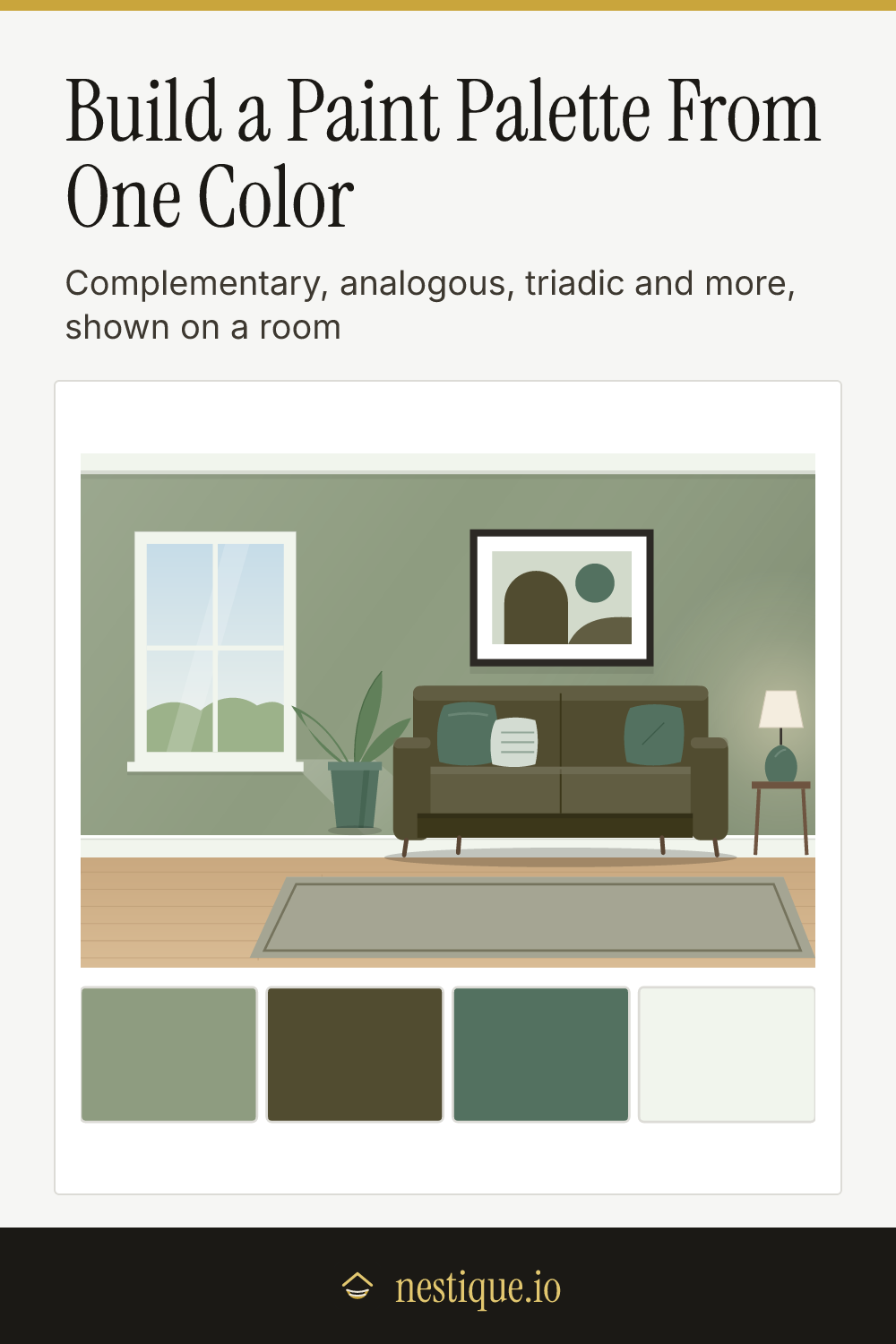
The generator builds a palette of each type from that color and paints the one you pick onto the living room:
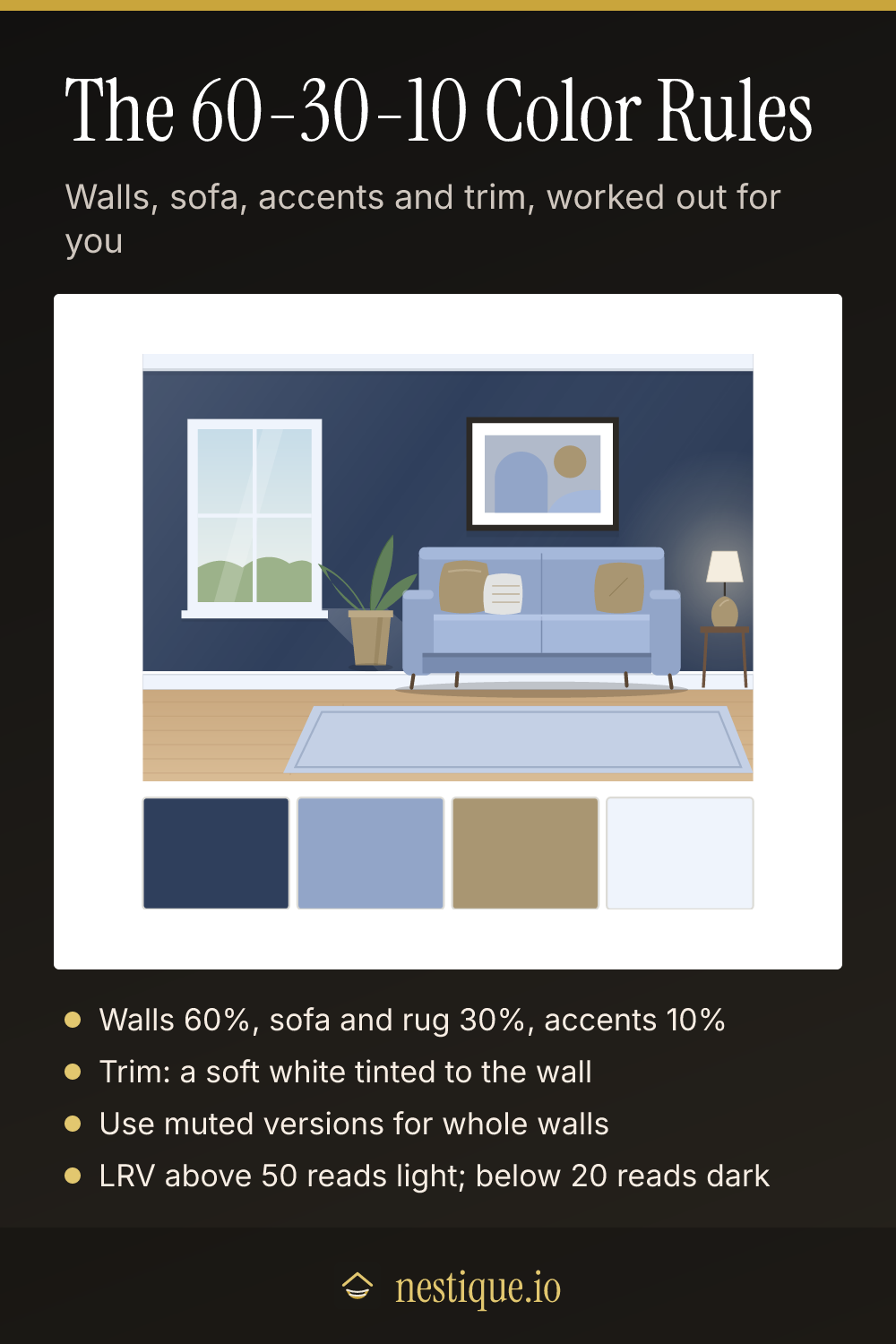
- Walls get your starting color.
- The sofa and rug get the palette’s second color.
- Pillows, art, the lamp and the planter get the accent.
- Trim and ceiling get a soft white tinted toward your wall color.
Tap a palette to see it on the room. Every color has a copy button for its hex code and an LRV number on its chip. Use Muted (the default) for colors you would put on a whole wall, or True color to see the exact color-wheel math. Save the room as an image to take to the paint store.
The rules behind the palettes
The 60-30-10 split. About 60% of what you see in a room should be the main color, 30% a secondary color and 10% an accent. The room is drawn that way: walls are the 60, the sofa and rug the 30, and the small things the 10. Trim and ceiling white sit outside the split.
Color-wheel harmonies. Complementary colors sit opposite each other on the wheel, at 180 degrees. Analogous colors are neighbors, 30 degrees either side. A triad is three colors 120 degrees apart. Split complementary takes the two neighbors of the opposite color, at 150 and 210 degrees. Monochromatic keeps one hue and changes only how light or dark it is.
Even steps. The generator turns hues in OKLCH, a color space built so that equal steps look equal to the eye. On a basic HSL color wheel, greens take up a wide slice and yellows a thin one, so the same 30 degree turn can look tiny or huge depending on where you start. In OKLCH the steps look about the same size from any starting color.
Value contrast. The sofa color is moved lighter or darker than the wall so the two read apart. On a light wall it goes deeper; on a dark wall it goes lighter.
Light reflectance value. LRV runs from 0 for black to 100 for white. Above about 50 a paint reads light, below about 20 it reads dark. The generator estimates LRV from the on-screen color.
Assumptions
Muted mode caps how saturated each color can be, strongest on the walls, because a color that looks fine on a small chip looks much stronger on four walls. True color skips the cap and keeps the exact harmony, which suits accents better than walls.
Screens are not paint. Brightness settings, the finish of the paint and the light in your room all change how a color looks. Treat the hex codes as a starting point for picking real paint chips, then test samples on your own walls in daylight and at night.
The room uses a light oak floor and green plants, which stay the same in every palette.
Worked example
Start with a sage green, hex #8E9C80, in Muted mode. Its estimated LRV is 31, so it reads as a mid-tone wall.
- Analogous keeps the sage walls, puts a deep olive (#514C30) on the sofa and rug, and uses a muted green (#537160) for the accents. Trim is a soft white, #F1F5ED. It is a calm, earthy room.
- Complementary keeps the same walls and trim, moves the sofa to a deeper sage (#445037) and uses a dusty plum (#70627C) for the accents. Plum sits opposite sage on the wheel, so the pillows and art suddenly stand out.
- Monochromatic stays all green: the same walls, the deeper sage sofa and an even darker green (#364229) for the accents.
Pick the one that matches the mood you want, copy the codes, and take them to the paint counter to find the closest chips.
Pin it for later
Paint Color Palette Generator FAQ
What is the 60-30-10 rule for paint colors?
It is a split for how much of each color you see in a room: about 60% for the main color (usually the walls), 30% for a secondary color (large furniture, a rug or curtains) and 10% for an accent (pillows, art, a lamp). Trim and ceiling white sit outside the split. It is a starting point, not a law.
What colors go with sage green?
Sage sits between green and gray, so it pairs well with its neighbors on the wheel: olive, deep teal and soft blue-greens for a calm analogous room. For more contrast, try a dusty plum or mauve accent, which sits opposite sage. Warm whites and natural wood suit it in almost every palette.
What is the difference between complementary and analogous colors?
Complementary colors sit opposite each other on the color wheel, like blue and orange, so they make the most contrast. Analogous colors sit next to each other, like green, blue-green and blue, so they blend. Analogous rooms feel calm; complementary rooms feel lively.
What does LRV mean on a paint chip?
LRV stands for light reflectance value. It runs from 0 (black) to 100 (white) and tells you how much light a paint reflects. Paints above about 50 read light and bounce light around a room; below about 20 they read dark and make a room feel cozier.
How many colors should a room have?
Three is the usual answer: a main color, a secondary color and an accent, plus white or off-white trim. Wood tones, black hardware and plants do not count against the three. More colors can work, but they are harder to balance.