How to use the wallpaper visualizer
Pick a pattern from the grid at the top. Every pattern is drawn in your current colors, so the thumbnails change as you try new combinations. The library runs from quiet stripes, polka dots and gingham to trellis, scallop, ogee, blossom branch, botanical leaf, Art Deco fan and damask-style medallions.
Then adjust it:
- Pattern scale. Slide from 50% to 200%. The label shows the repeat size, which is the width and height of one full motif before it starts again.
- Background and pattern color. Tap a swatch for each, or use the plus button for any color. If the two are too close to read as a pattern, the result panel tells you.
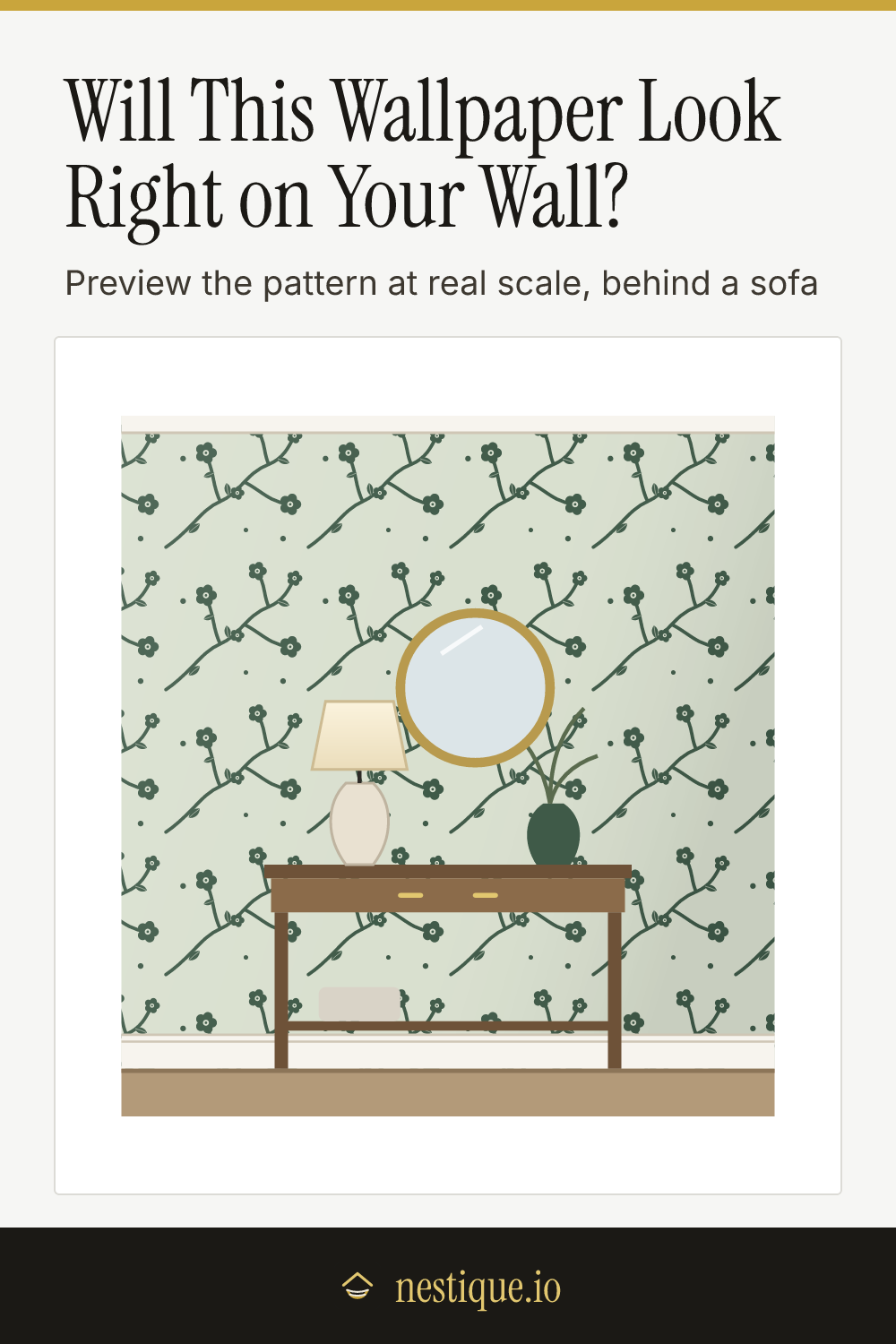
- Furniture for scale. Put an 84 inch sofa with a floor lamp, or a console table with a lamp and mirror, in front of the wall. Furniture is the best way to judge whether a repeat is too big or too small.
- Wall size. Enter the width and height of the wall. Switch to centimeters with the unit toggle, which also switches the roll estimate to metric rolls.
The result shows how many rolls to buy, how many repeats fit across the wall, and how the scale will read from across the room. Save the wall as an image to compare a few favorites side by side.
The rules behind the estimate
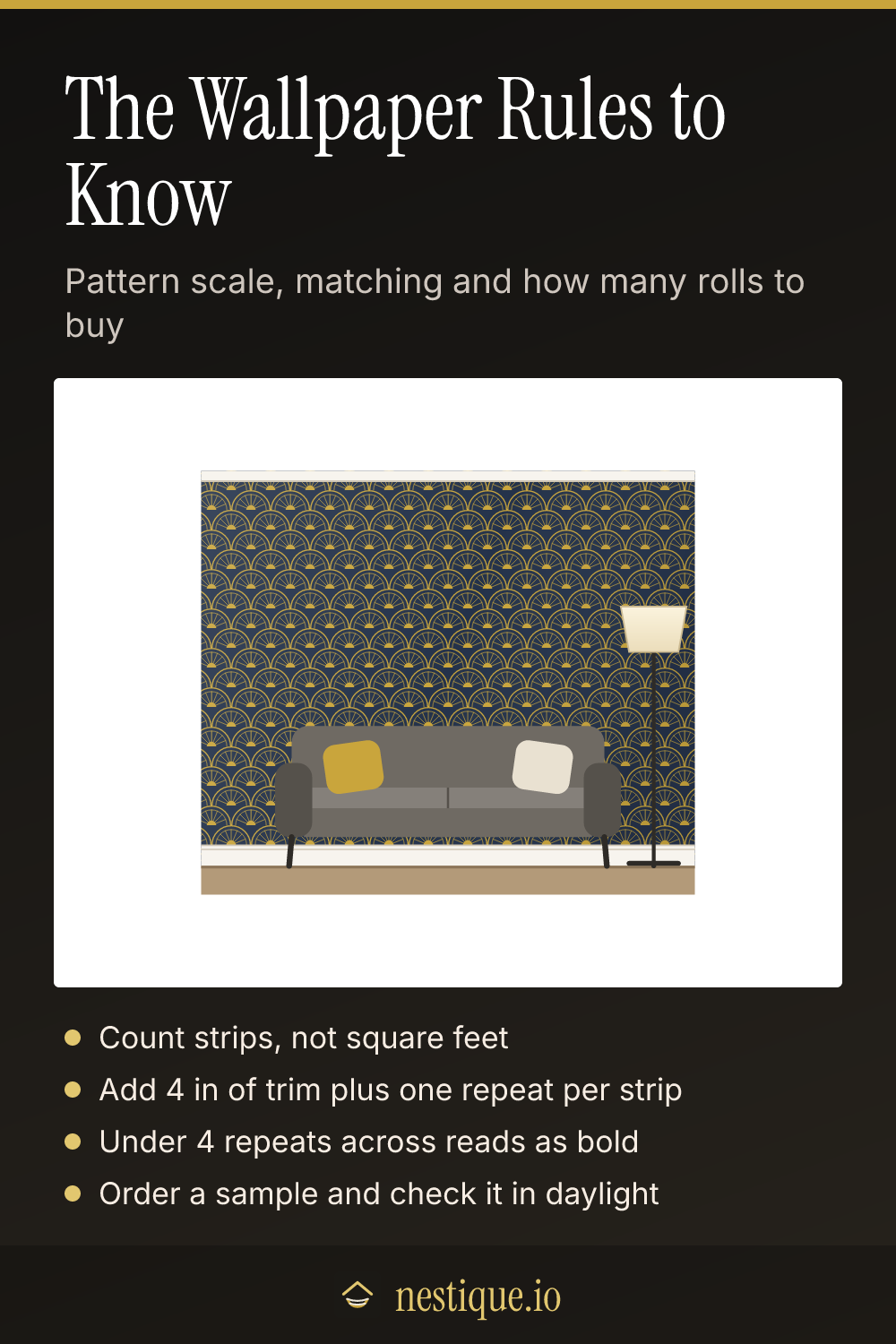
Strips, not square feet. Wallpaper goes up in vertical strips, so area alone undercounts. Divide the wall width by the roll width and round up to get the number of strips.
Each strip needs trim and a repeat. Cut every strip about 4 inches longer than the wall, 2 inches at the top and 2 at the bottom, so you can trim to the ceiling and baseboard. Then add one pattern repeat, so each strip can slide up or down until its motifs line up with the strip beside it.
Count strips per roll. Divide the roll length by the strip length and round down. The leftover piece at the end of each roll is waste. Divide the strips you need by the strips per roll and round up. That is the number of rolls.
Match the scale to the wall. A repeat that fits fewer than about four times across the wall makes a bold, feature-wall statement. Far more than a dozen and it starts to read as texture from across the room. In between is the comfortable range for most rooms.
Assumptions
The roll estimate uses a US double roll of 20.5 inches by 33 feet, or a metric roll of 53 centimeters by 10.05 meters. Check the label on your paper, because widths and lengths vary. Doors and windows are not subtracted. On most walls the strips above and below them still need most of a roll’s length, so the estimate stays on the safe side.
The repeat sizes are typical for each style of pattern. Real papers list their exact repeat and match type on the label and the sample. The patterns here are original drawings made for this tool, not copies of any maker’s designs.
Colors on screen are only a guide. Order a sample and look at it on the wall in daylight and at night before you buy.
Worked example
Say the wall is 12 feet wide and 8 feet tall, and you like the botanical leaf pattern with an 18 inch repeat.
- Strips: 144 inches divided by a 20.5 inch roll is just over 7, so you need 8 strips.
- Strip length: 96 inches of wall, plus 4 inches of trim, plus one 18 inch repeat, makes 118 inches, or 9 feet 10 inches.
- Strips per roll: a 33 foot roll is 396 inches, which gives 3 strips of 118 inches.
- Rolls: 8 strips divided by 3 per roll is 2.7, so buy 3 double rolls.
The pattern fits 8 times across the wall, which reads clearly without feeling busy. At 50% scale it fits 16 times and starts to look like texture, but you still need 3 rolls. Switch to the damask medallion at 200% and the repeat grows to 40 by 56 inches. Each strip becomes 156 inches long, only 2 fit on a roll, and the same wall needs 4 rolls.
Pin it for later
Wallpaper Visualizer FAQ
How do I choose the right wallpaper pattern size?
Count how many repeats fit across the wall. Fewer than about four makes a bold statement and suits a large room or an accent wall. Somewhere between four and a dozen or so reads clearly from across the room. Much smaller than that, and the pattern blurs into texture.
How many rolls of wallpaper do I need?
Divide the wall width by the roll width to get the number of strips. Each strip is the wall height plus about 4 inches of trim plus one pattern repeat. Divide the roll length by the strip length, round down, and that is how many strips each roll gives you. A 12 x 8 foot wall with an 18 inch repeat takes 3 US double rolls.
What is a half-drop match?
In a half-drop match the pattern on every other strip sits half a repeat lower, so motifs step diagonally across the wall. It hides seams well but can need a little more paper than a straight match, where motifs line up straight across.
Does wallpaper with a large pattern make a room look smaller?
Not necessarily. A large, airy pattern on a light ground can make a small room feel bigger, because the eye reads fewer edges. Dark grounds and dense, busy patterns pull the walls in. Try both in the visualizer at your wall size.