How to use the closet planner
Pick the closet type first. Reach-in is the standard bedroom closet behind sliding or bifold doors. His & hers splits a wider closet into two hanging zones with shelves in the middle. Walk-in wall plans one long wall of a walk-in closet, with drawers and shoe shelves. Each preset is a starting point, not a final answer.
Next, enter the closet’s inside width, its height and its depth. Measure the width wall to wall inside the closet, not just the door opening. Measure the depth from the back wall to the front of the door frame. Type the numbers the way you would write them (6’ or 72”) or tap the minus and plus buttons. The unit toggle switches to centimeters.
Now make it yours. Tap any section in the drawing, or the buttons under it, and pick what it holds: long hang, double hang, shelves, drawers or shoes. Change a section’s width with the stepper, split it in two, or remove it. The section next to it grows or shrinks so everything still fits the wall. Set the spacing for folded-clothes shelves and shoe shelves with the steppers at the bottom.
The result totals your linear feet of hanging rod, the number of shelves and their length, the drawers and roughly how many pairs of shoes the shoe shelves hold. The checks under it flag anything that breaks a rule. Tap a flagged row to jump to that section. Save the plan as an image to take to the hardware store or to a closet installer.
The rules behind the plan
Closet designers use a short list of measurements over and over. The planner places every rod and shelf with them.
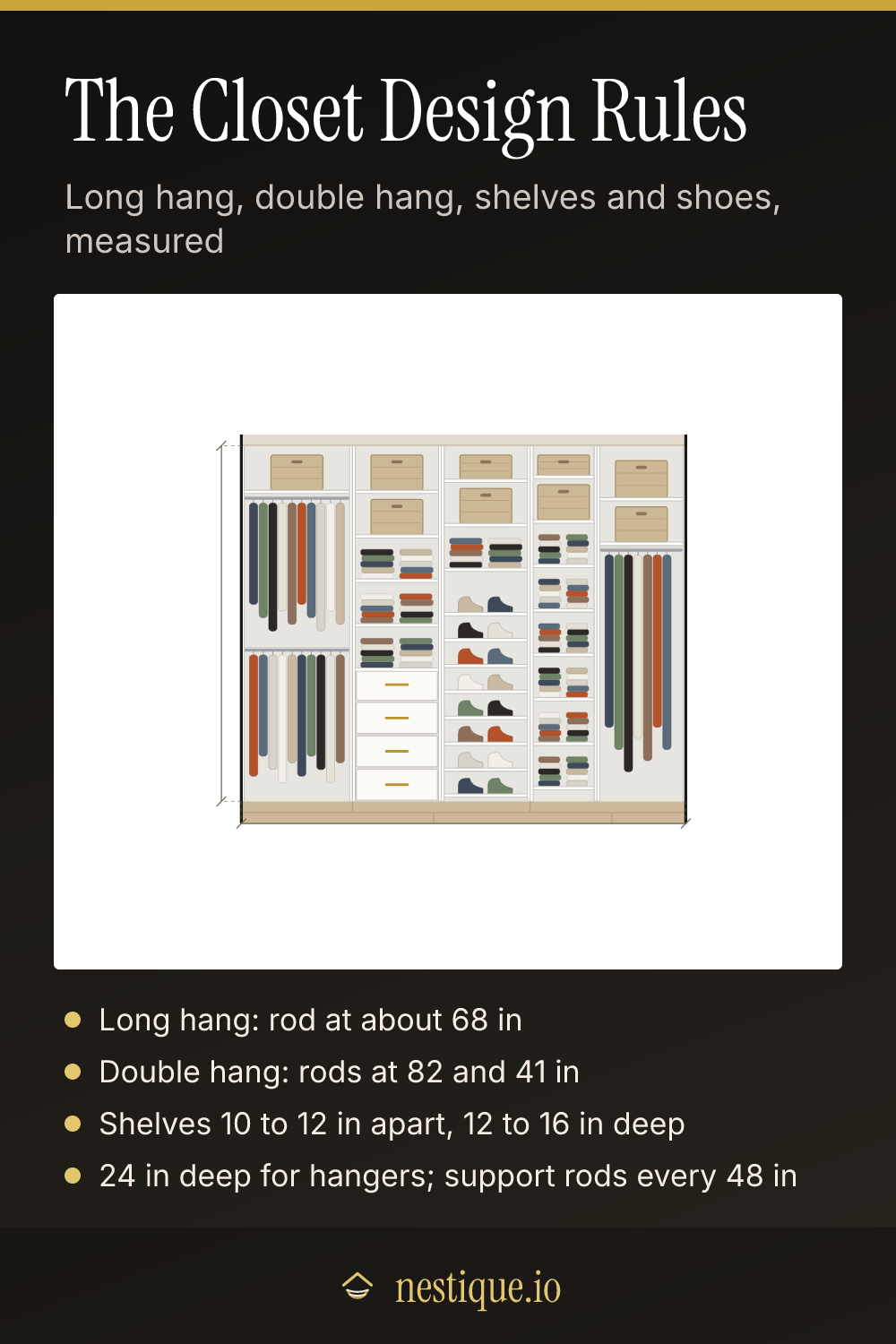
Long hang: rod at about 68 inches. Dresses, coats and full-length trousers need 60 to 66 inches of drop. A rod at 68 inches leaves room for the hanger and keeps hems off the floor. A shelf goes about 2 inches above it.
Double hang: rods at 82 and 41 inches. Shirts, jackets and trousers folded over a hanger need about 36 to 40 inches. Two rods about 40 inches apart, at 80 to 84 inches and 40 to 42 inches, fit two rows in the same width.
Shelves: 10 to 12 inches apart. That fits a neat stack of sweaters or jeans. Closer and you can only fit a few items. Farther apart and stacks get tall enough to topple when you pull from the bottom. Shelves should be 12 to 16 inches deep.
Shoes: 6 to 8 inches apart. Flats, sneakers and dress shoes fit on shelves about 7 inches apart. Boots need more room. Each pair takes about 8 inches of shelf.
Depth: 24 inches for hanging. A hanger is about 17 to 19 inches wide, so clothes facing forward need about 24 inches of depth, and 22 inches is the minimum.
Support rods every 48 inches. A rod longer than about 48 inches sags under a full load. The planner suggests a center support for wider hanging sections.
Assumptions
Drawers are drawn as a stack of four 9 inch drawers, up to about dresser height, with shelves above. Shoe shelves run from near the floor to about 56 inches, with regular shelves above them. Above every rod, the planner adds shelves at your spacing as long as at least 8 inches of space is left above the top one.
Totals measure the full width of each section, so subtract a little for the side panels when you buy rods and shelving. Shoe counts assume adult shoes side by side and are only an estimate.
The planner draws one wall. For a walk-in closet, plan each wall separately. Corner units, doors that swing into the closet, and lights or vents are not modeled.
Worked example
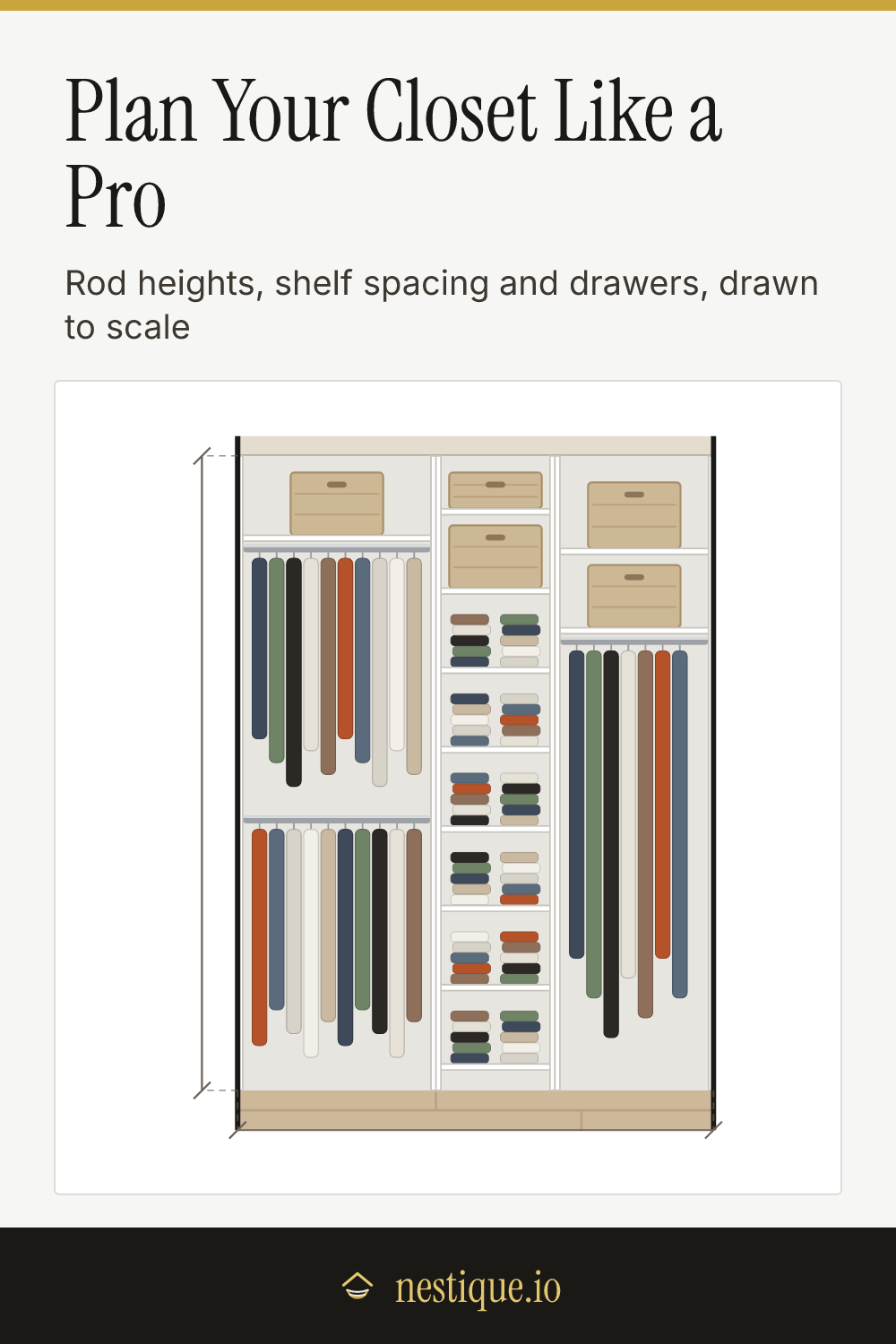
Say the closet is a 6 foot reach-in, 96 inches tall and 24 inches deep, with shelves 12 inches apart. The reach-in preset splits it three ways.
- A 30 inch double-hang section gets rods at 41 and 82 inches and one shelf at 84 inches.
- An 18 inch shelf tower gets 8 shelves, from 4 inches off the floor up to 88 inches.
- A 24 inch long-hang section gets a rod at 68 inches, with two shelves above it at 70 and 82 inches.
That adds up to 7 feet of hanging rod (5 feet of short hang and 2 feet of long hang) and 11 shelves, about 18.5 feet of shelf in all. Every check passes: the depth suits hangers, the rods span under 48 inches, and the shelf spacing sits in the 10 to 12 inch range.
Swap the shelf tower for drawers and you trade three shelves for four drawers: the plan then has 8 shelves and 4 drawers. Switch to the walk-in wall preset and a 10 foot wall gets the same 7 feet of hanging, 19 shelves, 4 drawers and room for about 16 pairs of shoes.
Pin it for later
Closet Planner FAQ
How high should a closet rod be?
For long hang (dresses, coats, long trousers), put the rod at about 66 to 68 inches so long clothes get 60 inches or more of drop. For double hang, put the top rod at 80 to 84 inches and the bottom rod at 40 to 42 inches.
How far apart should closet shelves be?
Space shelves for folded clothes 10 to 12 inches apart. That holds a stack of sweaters or jeans you can pull from without the pile falling over. Shoe shelves can be closer, about 6 to 8 inches, with more room for boots.
How deep does a closet need to be for hanging clothes?
A closet needs about 24 inches of depth for clothes on hangers, and 22 inches is the practical minimum. Shelves for folded clothes only need 12 to 16 inches.
What is the difference between long hang and double hang?
Long hang is one rod at about 68 inches for dresses, coats and trousers hung full length. Double hang stacks two rods, at about 82 and 41 inches, for shirts, jackets and folded trousers. Double hang gives you twice the rod in the same width, so most closets use it for everything that is short enough.
How long can a closet rod span without support?
Support a closet rod at least every 48 inches. A longer span sags under the weight of a full rod of clothes. The planner flags any hanging section wider than that.