How to use the chandelier height calculator
First, tell the calculator where the chandelier hangs. Over a table is for dining rooms and eat-in kitchens. Open floor or entry is for foyers, living rooms, bedrooms and anywhere people walk underneath.
Next, enter the ceiling height where the fixture will hang, measured from the floor. Then add the room’s width and length. Over a table, also set the table’s shape and size. Type measurements the way you would write them (9’ or 108”) or tap the minus and plus buttons. The unit toggle switches to centimeters.
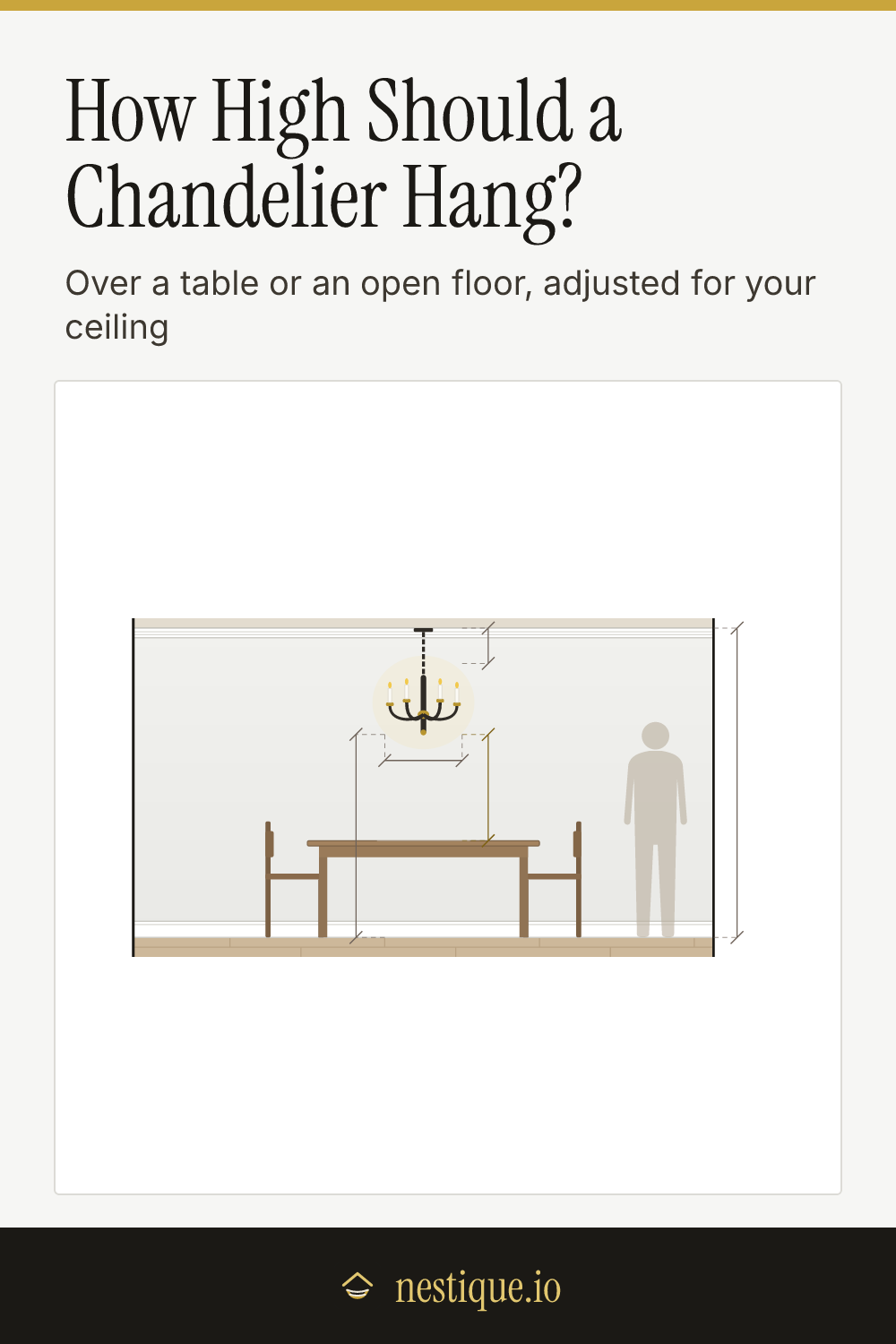
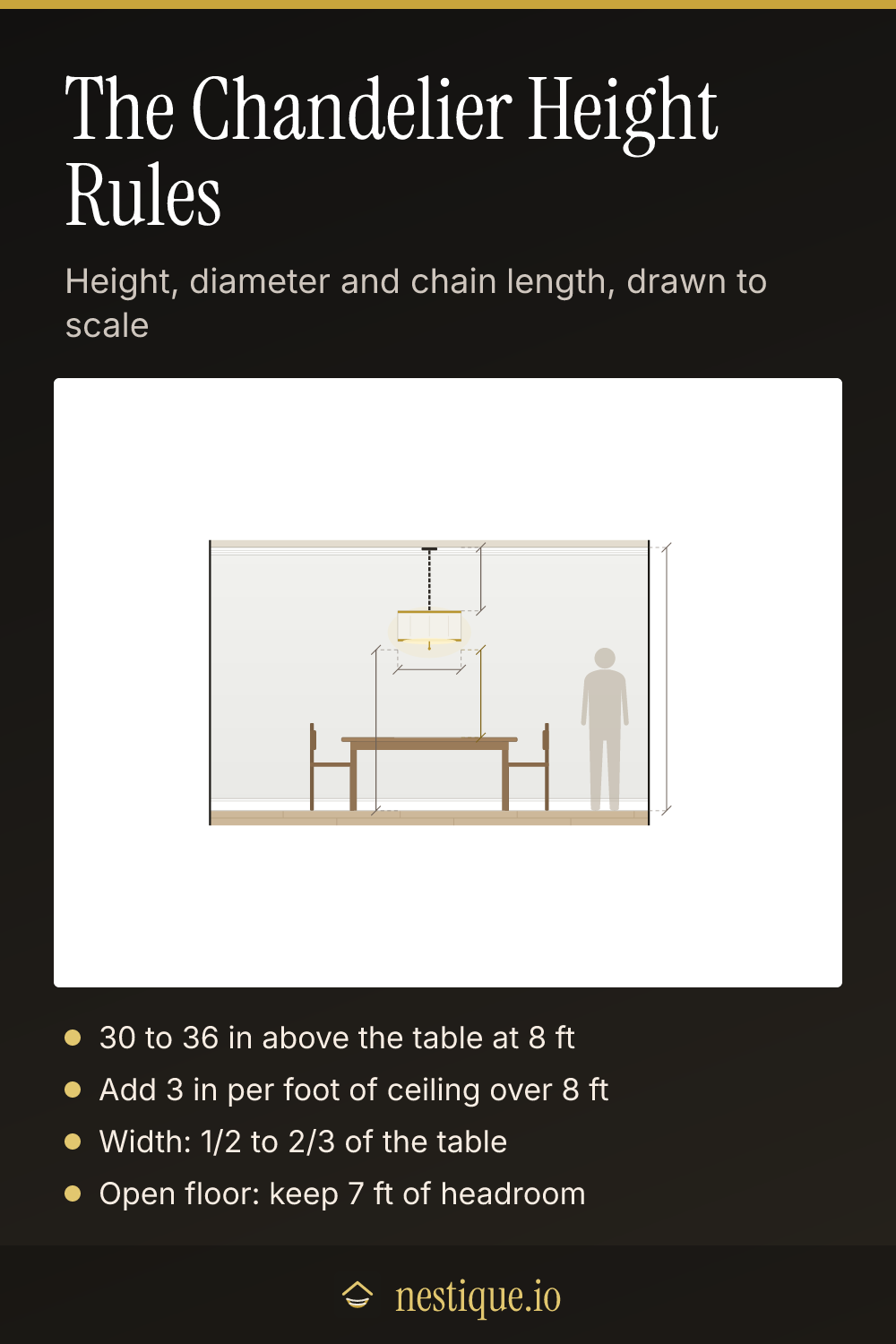
The calculator answers right away. The first panel tells you how high to hang the fixture, measured from the tabletop or the floor, and how long the chain or rod needs to be. The drawing shows the chandelier to scale over your table, with chairs and a standing person so you can judge it by eye.
Below that, tap through the standard chandelier diameters. Each one turns green when it suits your table or room, amber when it is too small and red when it is too big. The one marked “Best” is closest to the ideal. Pick a style and, if you have a fixture in mind, set its height. The chain length updates to match. Save the drawing as an image to send to your electrician.
The rules behind the height and size
Lighting designers and fixture makers repeat the same handful of rules. Here they are, so you can see where every number comes from.
30 to 36 inches above the table. With an 8 foot ceiling, the bottom of a dining chandelier should sit 30 to 36 inches above the tabletop. Lower and it blocks the view across the table. Higher and it stops feeling connected to it. The calculator aims for the middle of the range.
3 more inches for every foot of ceiling over 8 feet. Taller rooms pull the fixture up. A 9 foot ceiling adds 3 inches and a 10 foot ceiling adds 6. The calculator stops adding at 12 inches, so in a very tall room the fixture still relates to the table below it.
At least 7 feet of headroom over open floor. Anywhere people walk under a fixture, keep the bottom at least 84 inches from the floor. The same ceiling adjustment raises it in taller rooms.
Half to two-thirds of the table width. Over a table, choose a diameter between 1/2 and 2/3 of the table’s width, and keep it at least 12 inches narrower than the table. That way no one hits it when they stand up from the side.
Room length plus width. For a fixture that lights the whole room, add the room’s length and width in feet and use that number in inches. A 12 by 14 foot room calls for about 26 inches.
2.5 to 3 inches of height per foot of ceiling. A fixture’s body, without the chain, looks right at about 2.5 to 3 inches tall for every foot of ceiling height.
Assumptions
Dining tables are taken as 30 inches tall, which is standard. The calculator hangs the fixture from the center of the ceiling over the center of the table. The chain or rod length is measured from the ceiling to the top of the fixture body, so the canopy and any loop of chain inside it are extra.
Fixture height defaults to a typical shape for each style: candle-arm fixtures are almost as tall as they are wide, drums are shallower, and globes are as tall as they are wide. Real fixtures vary, so set the height of the one you like.
Sloped and vaulted ceilings are not modeled. Measure the ceiling height at the spot where the canopy will mount.
Worked example
Say the dining room is 12 by 14 feet, with an 8 foot ceiling and a 72 by 40 inch table.
- Height: the bottom of the fixture goes 33 inches above the table, the middle of the 30 to 36 inch range. That is 63 inches, or 5’ 3”, from the floor.
- Diameter: half to two-thirds of the 40 inch table width is 20 to about 27 inches. The calculator suggests 24 inches. The room rule gives 26 inches, so 24 inches suits the room as well.
- Fixture height: an 8 foot ceiling suits a fixture 20 to 24 inches tall. A 24 inch candle-arm chandelier is about 22 inches tall, so it needs about 11 inches of chain.
Raise the same ceiling to 10 feet and the fixture moves up 6 inches, to 39 inches above the table. The chain grows to about 29 inches. Move the same fixture to an entry with an 8 foot ceiling and it fails. At 22 inches tall it can’t keep 7 feet of headroom, so you need one 12 inches tall or less, or a flush mount.
Pin it for later
Chandelier Height Calculator FAQ
How high should a chandelier hang over a dining table?
With an 8 foot ceiling, hang it so the bottom is 30 to 36 inches above the tabletop. Add about 3 inches for every foot of ceiling over 8 feet, so a 10 foot ceiling puts it 36 to 42 inches above the table.
What size chandelier do I need for my dining table?
Pick a diameter between half and two-thirds of the table width, and at least 12 inches narrower than the table. For a 40 inch wide table that is 20 to about 27 inches, so a 24 inch fixture is a safe choice.
How do I size a chandelier for a room?
Add the room length and width in feet and use that number in inches. A 12 by 14 foot room adds up to 26, so look for a fixture about 26 inches across. Over a table, the table width matters more than the room.
How low can a chandelier hang in an entry or living room?
Keep at least 7 feet (84 inches) of clear headroom under any fixture people walk beneath. In a room with an 8 foot ceiling that leaves only 12 inches for the fixture, so a flush or semi-flush mount usually works better.
How tall should a chandelier be?
A common rule is 2.5 to 3 inches of fixture height for each foot of ceiling height. With an 8 foot ceiling that means a fixture about 20 to 24 inches tall, not counting the chain.