How to use the cabinet pull size calculator
Choose drawer or door first. Drawer pulls run sideways and are sized by the drawer’s width. Door pulls run up and down and are sized by the door’s height.
Next, enter the size of the front itself, edge to edge, not the cabinet box behind it. Type it the way you would write it (24” or 2’) or tap the minus and plus buttons. Switch to centimeters with the unit toggle and the pull sizes switch to millimeters, the way metric hardware is sold.
Pick bar pulls or cup pulls. Cup pulls, the half-moon kind, only come in short sizes, so the list shrinks when you choose them.
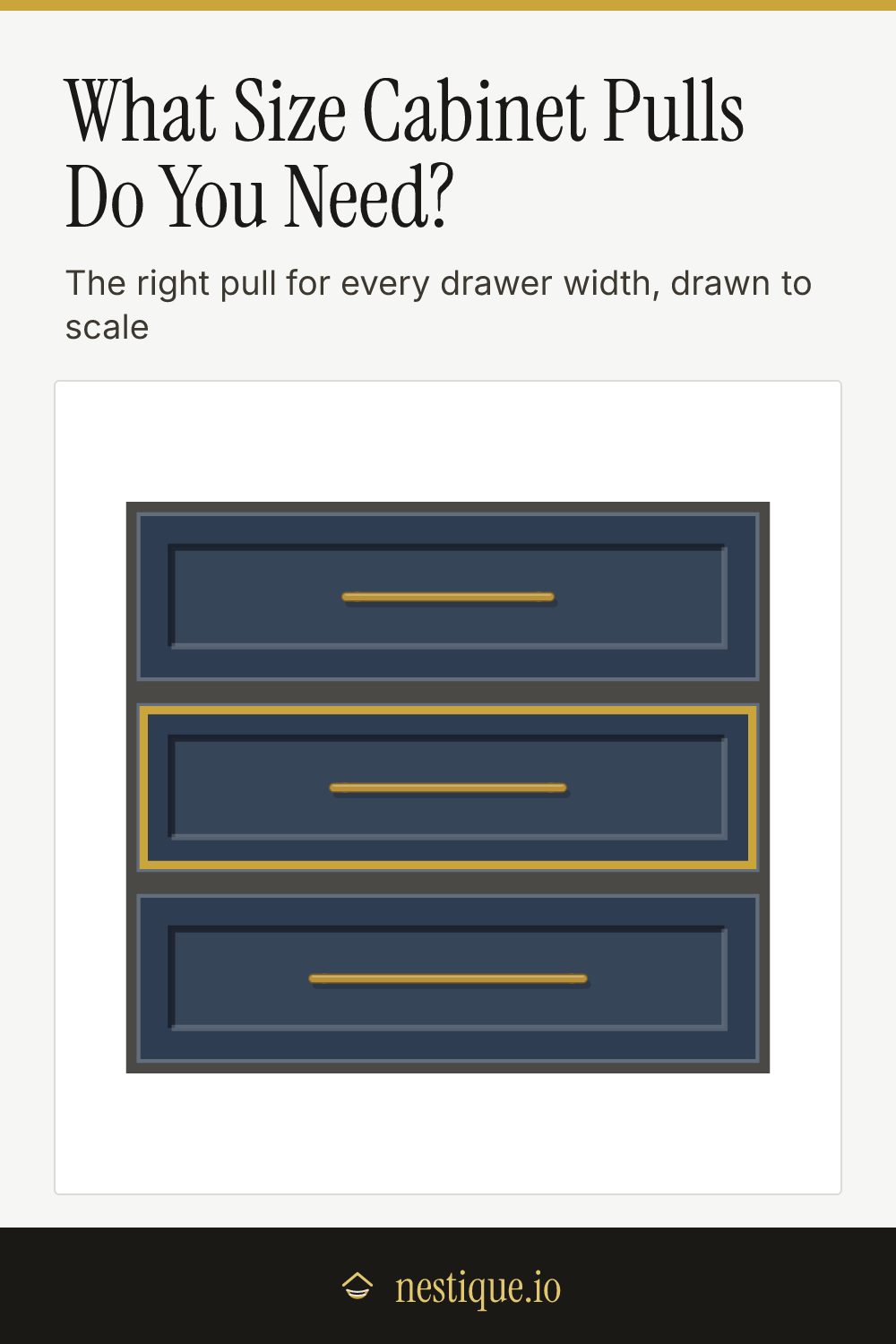
The calculator marks the closest standard size as Best and draws it on your drawer between the next size down and the next size up, all to scale. Every standard size is listed with a good fit, too small or too long verdict. Tap any of them, or use the arrows, to see it drawn and explained. The result panel gives the hole spacing (center to center), the overall length, and how much of the front is left at each end. Pick a cabinet color and a hardware finish, then save the drawing as an image to take to the store.
The rules behind the sizes
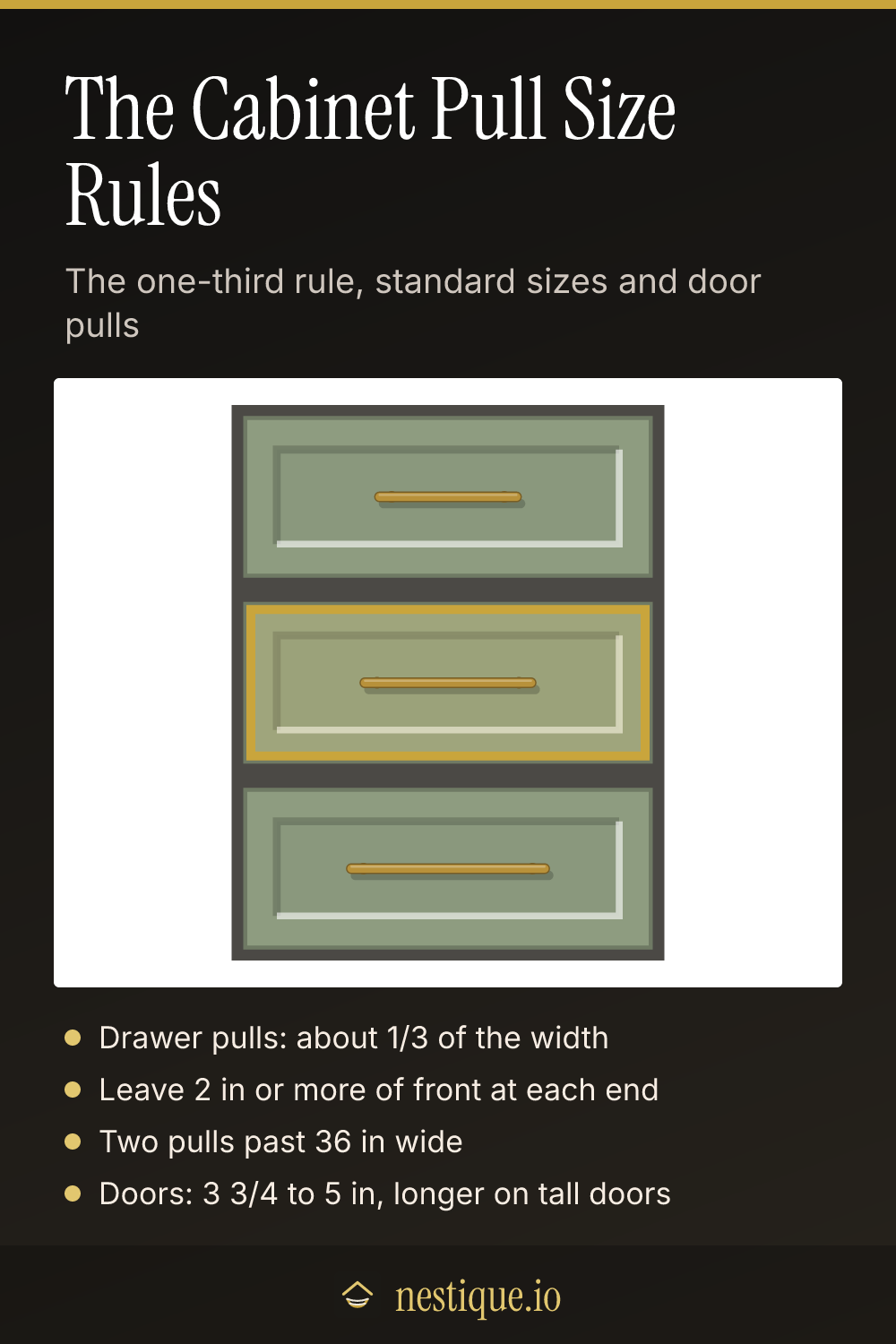
Drawer pulls: about a third of the width. The most repeated rule for drawer pulls is that the pull should be about one third as long as the drawer is wide. It is long enough to look intentional and short enough to leave plenty of drawer front on each side. The calculator treats anything from about a quarter to just over 40% of the width as a good fit.
Round to a size you can buy. Pulls are sold by the distance between their screw holes, in a fixed set of sizes: 3 inches, 3 3/4 inches (96 mm), 5 inches (128 mm), 6 5/16 inches (160 mm), 7 1/2 inches (192 mm), 8 13/16 inches (224 mm), 10 inches (256 mm) and 12 inches (305 mm). The one-third length rarely lands on one exactly, so the calculator picks the nearest.
Leave room at the ends. Whatever the ratio, a pull that leaves less than about 2 inches of drawer front past each end looks crammed. Those sizes are marked too long.
Very wide drawers get two pulls. Past about 36 inches, a single pull would have to be very long, and pulling a wide drawer from the middle can make it rack. Two pulls, each sized for half the drawer and centered at the quarter points, look better and work better.
Door pulls scale with height. On doors, the usual picks are 3 3/4 inches on standard base and upper doors, 5 inches on tall uppers, 7 1/2 inches on tall doors up to 6 feet, and 12 inches or more on pantry and panel doors.
Assumptions
The sizes quoted are center to center, the spacing between the two screw holes. Bar pulls are assumed to be about 1 1/2 inches longer overall than their hole spacing, and cup pulls about 7/8 inch longer. Real pulls vary, so check the overall length of the one you like before you order.
The one-third rule is applied to the hole spacing, because that is how pulls are sold, rather than the overall length. Measuring the overall length instead would push every answer one size smaller, which also works if you prefer a lighter look.
Fronts are drawn as shaker drawers and doors with the pull centered on the drawer, or near the top corner of a lower door. For where to drill, use the cabinet hardware placement tool.
Worked example
Say your drawers are 24 inches wide.
- One third of 24 inches is 8 inches. No standard pull is exactly 8 inches, so the calculator rounds to the nearest size: 7 1/2 inches, sold as 192 mm.
- That pull is about 9 inches long overall, so it leaves 7 1/2 inches of drawer front at each end. Its hole spacing is 31% of the drawer width, right in the good range.
- One size down, 6 5/16 inches (160 mm), also passes, for a lighter look. One size up, 8 13/16 inches (224 mm), passes too, if you like a bolder pull.
- 3 3/4 inches (96 mm) is too small. At about 16% of the width it looks lost on a drawer this size.
The same kitchen’s 30 inch drawers would take 10 inch (256 mm) pulls, and the 18 inch drawers 6 5/16 inch (160 mm) pulls. A 42 inch drawer switches to two pulls, 7 1/2 inches each.
Pin it for later
Cabinet Pull Size Calculator FAQ
What size pulls should I use on drawers?
A good rule is a pull about one third of the drawer width. A 24 inch drawer suits an 8 inch pull, so the closest standard size is 7 1/2 inches (192 mm). An 18 inch drawer suits about 6 inches, and a 30 inch drawer about 10 inches.
What does center to center mean for cabinet pulls?
It is the distance between the centers of the two screw holes, and it is how pulls are sized and sold. The overall length is longer: bar pulls usually run about 3/4 inch past each hole. If you are replacing pulls, match the center-to-center size so the old holes line up.
What size pulls go on cabinet doors?
Door pulls mount vertically and scale with the door height rather than the width. Standard base and upper doors take 3 to 5 inch pulls, tall upper doors 5 to 6 inches, and pantry or panel doors 10 to 12 inches or longer.
Should all cabinet pulls be the same size?
Not necessarily. Many kitchens use one size on standard drawers and doors and a longer size on wide drawers and pantry doors. Keep it to two or three sizes and use the same finish throughout so it still looks like one set.
When do you use two pulls on a drawer?
On very wide drawers, usually over 36 inches, two pulls look better and let you open the drawer without it racking. Size each one for its half of the drawer and center them at the quarter points.