How to use the cabinet hardware placement tool
Start with the hardware mix. Knobs on the doors with pulls on the drawers is the most common combination, but you can try all pulls, all knobs, or pulls with cup pulls on the drawers.
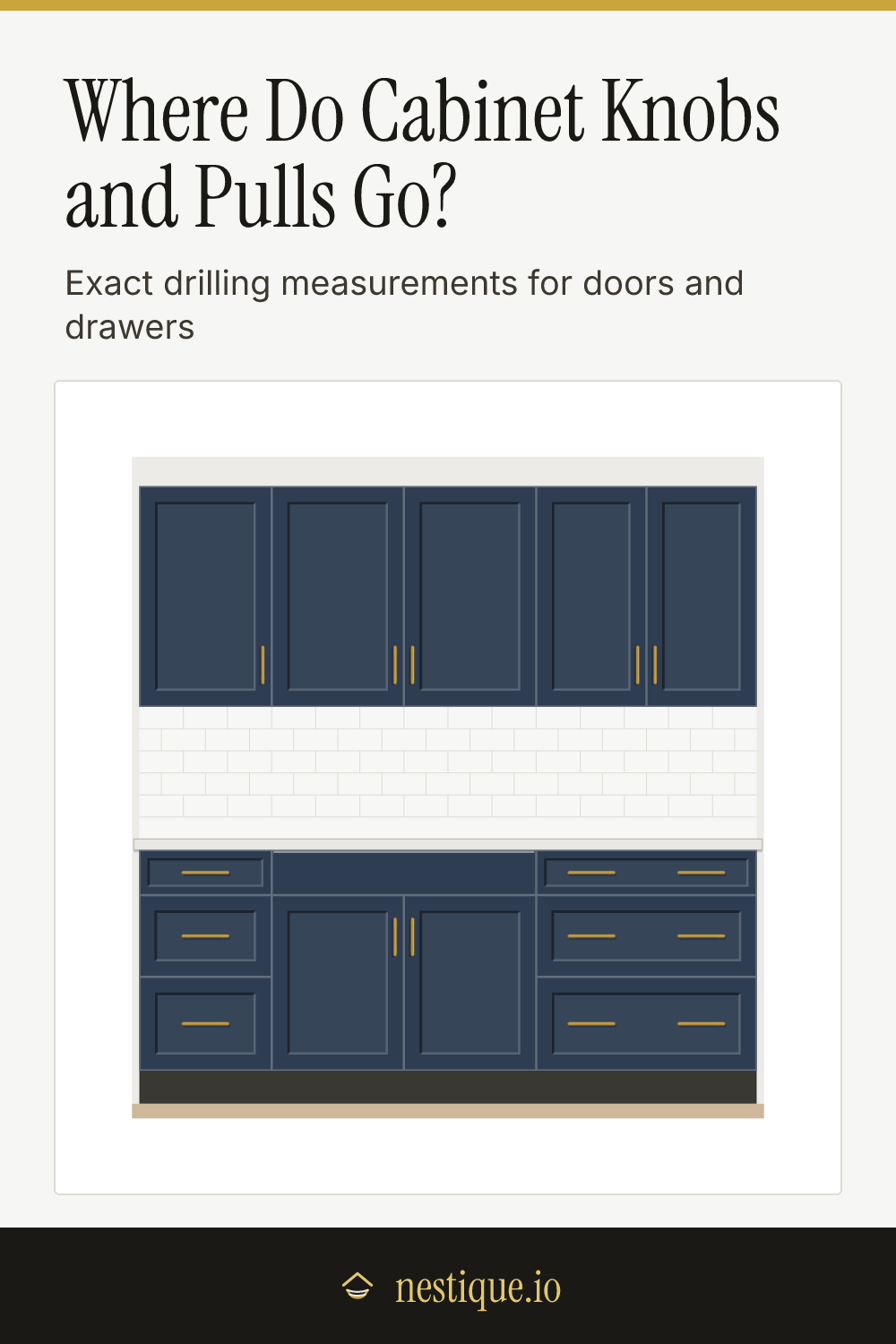
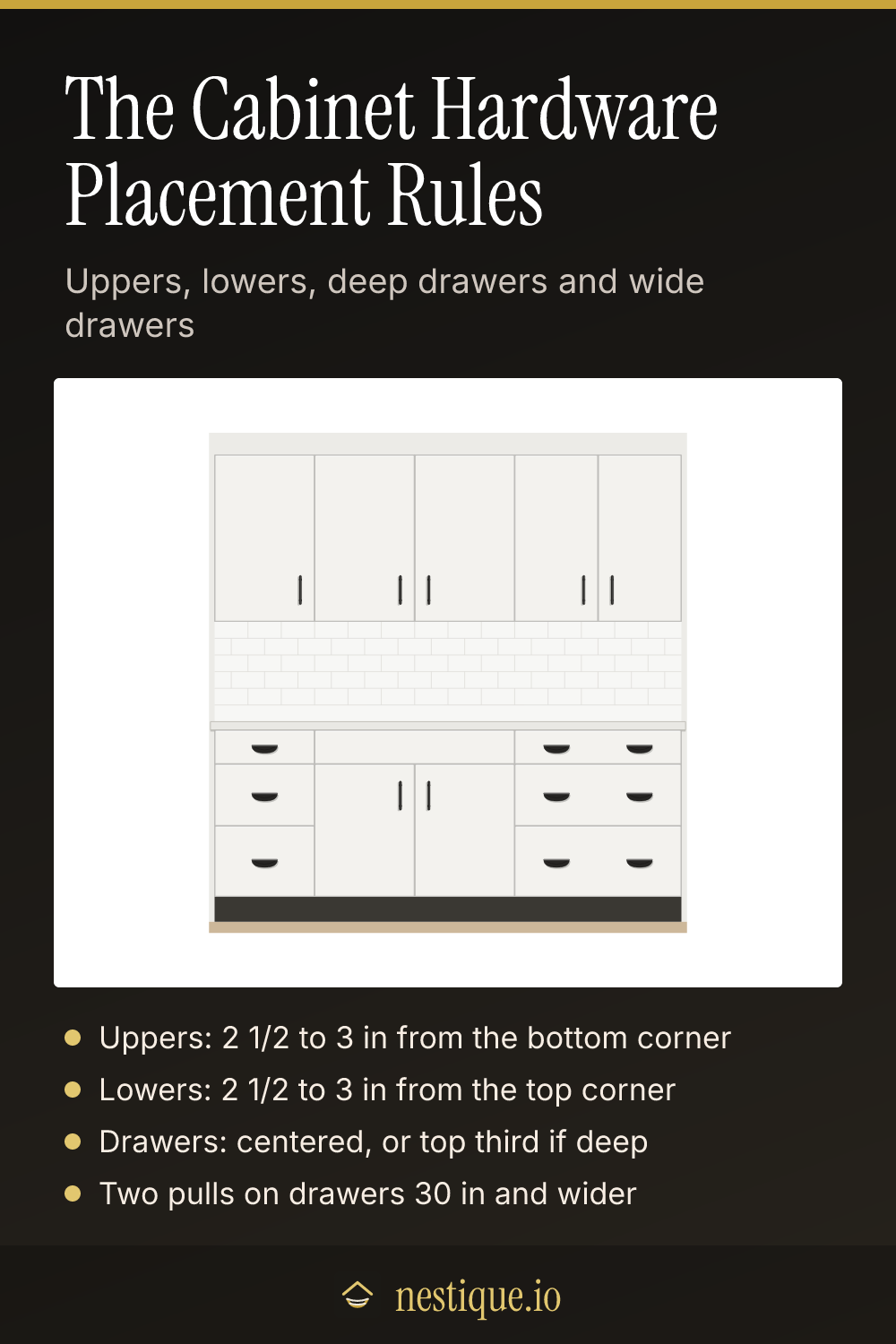
The drawing shows a short run of kitchen cabinets: upper cabinets, a sink base with a false front, and two drawer stacks, one 18 inches wide and one 30 inches wide. Every knob and pull is placed by the rules below, to scale.
Next, tap the kind of front you are about to drill: upper doors, lower doors, top drawers, deep drawers or wide drawers. Those fronts light up in the kitchen, and a close-up shows one of them with every hole marked in red and the distances from the edges. The list under it gives the same numbers to mark with a pencil and a square.
Then fine-tune the details:
- Door style: shaker doors have a frame around a flat center panel; slab doors are flat.
- Pull sizes: the center-to-center hole spacing, from 3 inches (76 mm) up to 12 inches (305 mm).
- Corner distance: how far the knob, or the end of the pull, sits from the bottom of an upper door or the top of a lower one.
- Deep and wide drawers: centered or a third of the way down, and two pulls or one long one.
Switch to millimeters with the unit toggle if your hardware is sold in metric. Pick a cabinet color and a finish to see the look, then save the drawing as an image.
The rules behind the placement
Doors open from the corner you reach first. Hardware goes on the side away from the hinges. On upper cabinets it sits near the bottom corner, because your hand comes up from below. On lower cabinets it sits near the top corner, just under the counter.
Two and a half to three inches from the corner. On a slab door, put the knob 2 1/2 to 3 inches in from the edge and 2 1/2 to 3 inches from the bottom (uppers) or top (lowers). On a shaker door, center it on the stile, the frame along the edge, which is usually 2 1/4 inches wide. Pulls on doors run vertically, with the end nearest the corner at that same distance.
Drawers: center the pull. Pulls on drawers run horizontally and sit centered across the front. Shallow drawers get the pull centered top to bottom too. On deep drawers, either center it or place it a third of the way down, so it sits closer to the top drawers’ pulls. Choose one and keep it consistent.
Wide drawers: two pulls or one long one. Somewhere between 24 and 30 inches wide, one ordinary pull starts to look lost, and pulling a wide drawer from the middle can make it rack. Use two pulls centered at the quarter points, or one long pull about a third of the drawer width.
Assumptions
The cabinets are full overlay, with a 1/8 inch gap between fronts. Base cabinets are 34 1/2 inches tall on a 4 1/2 inch toe kick, the counter is at 36 inches, and the upper cabinets are 30 inches tall, starting 18 inches above the counter. The drawer stacks have a 6 inch top drawer over 11 and 12 5/8 inch drawers.
All measurements are taken from the edges of the door or drawer front, not the cabinet box. Knobs are 1 1/4 inches across. Bar pulls are about 1 1/2 inches longer overall than their hole spacing, and cup pulls about 7/8 inch longer. Check your own hardware’s overall length before you drill.
Hinge sides are typical: single doors at the end of a run hinge on the outside, and pairs of doors hinge on the outer edges and open from the middle.
Worked example
Say you have shaker cabinets with knobs on the doors and 5 inch (128 mm) bar pulls on the drawers.
- Upper doors: each knob sits 1 1/8 inches in from the opening edge, centered on the 2 1/4 inch stile, and 3 inches up from the bottom.
- Lower doors: the same 1 1/8 inches in, and 3 inches down from the top.
- Top drawers on the 18 inch stack: the front is 17 7/8 inches wide and 6 inches tall. The pull is centered, so both holes are 3 inches down from the top, at 6 7/16 and 11 7/16 inches from the left edge.
- The 12 5/8 inch deep drawer: centered, the holes are 6 5/16 inches down. Placed a third of the way down, they are 4 3/16 inches down.
- The 30 inch drawers: two pulls, each centered about 7 1/2 inches in from its end. Switch to one long pull and the tool picks a 10 inch pull, a third of the drawer width.
Switch the doors to 3 3/4 inch pulls and the uppers change too: the lower hole sits 3 3/4 inches up from the bottom and the upper hole 7 1/2 inches up, so the end of the pull is 3 inches from the corner.
Pin it for later
Cabinet Hardware Placement Tool FAQ
Where do you put knobs on upper cabinet doors?
On the side away from the hinges, near the bottom corner: about 2 1/2 to 3 inches up from the bottom and 2 1/2 to 3 inches in from the edge on a slab door. On a shaker door, center the knob on the stile, the flat frame along the edge.
Where do you put knobs on lower cabinet doors?
Mirror the uppers: near the top corner on the side away from the hinges, about 2 1/2 to 3 inches down from the top. That is the corner your hand reaches first when you stand at the counter.
Where do pulls go on drawers?
Centered left to right, and centered top to bottom on shallow drawers. On deep drawers you can center the pull or put it about a third of the way down, which keeps it closer to the top drawer pulls. Pick one and use it on every deep drawer.
When should a drawer have two pulls?
Once a drawer reaches about 24 to 30 inches wide, one standard pull starts to look small and the drawer can rack when you pull it from the middle. Use two pulls at the quarter points, or one long pull about a third of the drawer width.
Do you measure from the cabinet box or the door?
From the door or drawer front itself. Fronts overlap the box by different amounts, so measuring from the box puts hardware in the wrong place. Make a simple template from scrap wood and use it on every matching front.