How to use the flooring cost calculator
Choose at the top whether a pro is installing the floor or you are doing it yourself. Do-it-yourself prices drop the installation line and keep everything else.
Enter the room’s width and length, wall to wall. Type feet and inches (12’ 6”) or a decimal (12.5), or tap the minus and plus buttons. Switch to centimeters and every price is shown per square meter instead. For an L-shaped room, add the two rectangles’ areas together and enter a room with the same total, such as 10 by the combined length.
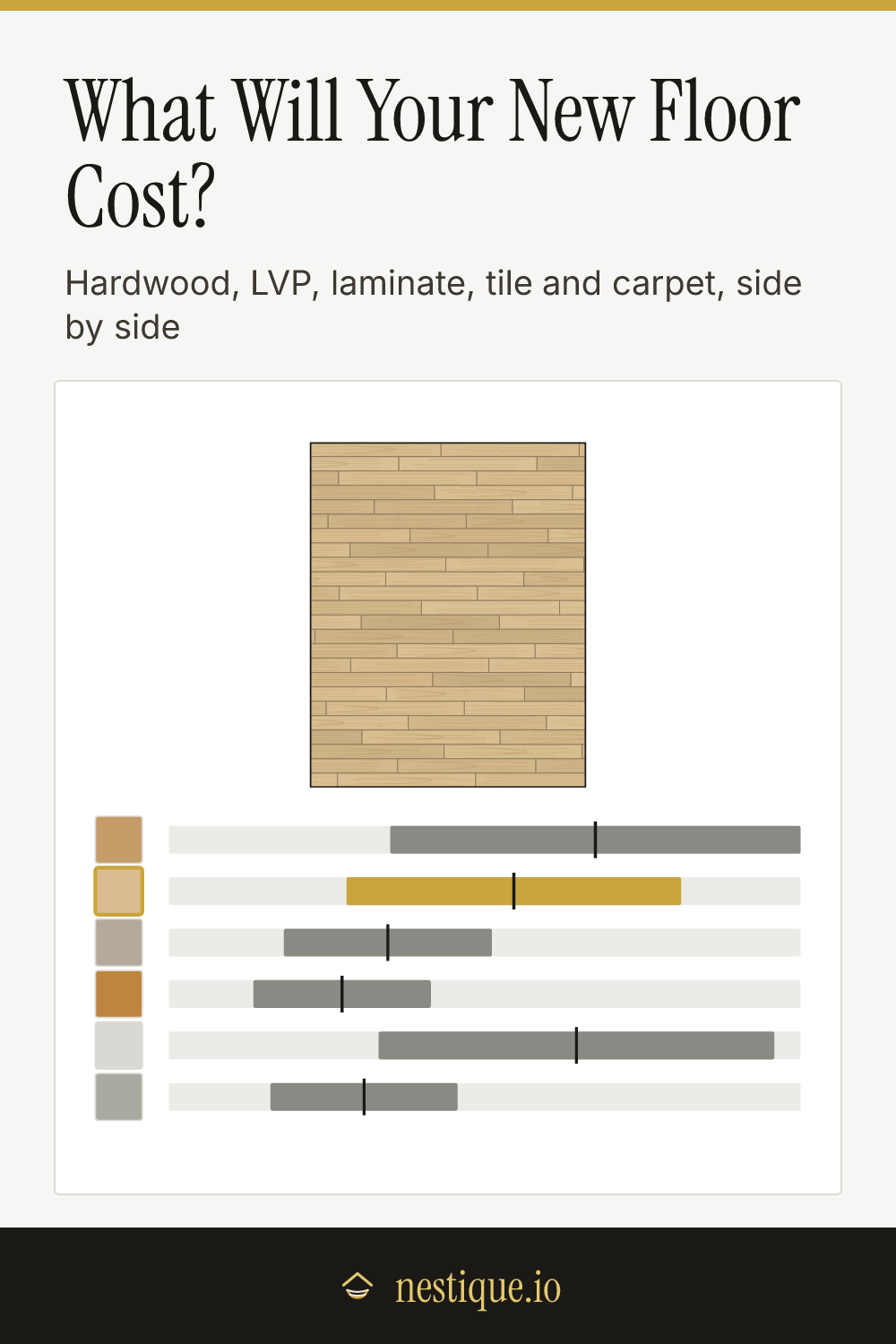
The comparison updates as you go. Each floor type gets a bar running from its low estimate to its high estimate, with a dark mark at the middle. Tap any of them to make it the floor you are pricing. The drawing switches to that floor, and the panel below breaks the total into material, installation, underlayment and removal.
Turn Include underlayment off if your floor has a pad attached, which many vinyl planks do. Turn Remove the old floor on if the old carpet or laminate has to come up first.
The prices are typical US ranges, not quotes. Once you have real numbers, put them into the price boxes for the floor you picked. The calculator keeps your edits for each floor, and Reset to typical puts them back. Save the comparison as an image to bring to the store or to a meeting with an installer.
The rules behind the estimates
Material is bought for the area plus waste. You always buy more than the floor area, because the ends of rows, the last row and the pieces around door frames get cut. Plank floors and tile in a straight layout lose about 10%. Carpet comes off 12 foot wide rolls, so the waste depends on where the seams fall. The calculator uses 12% for carpet.
Installation is priced on the floor area. Installers quote per square foot of floor, not per square foot of material. Tile costs the most to install because every piece is set in mortar and grouted. Floating floors such as laminate and many vinyl planks click together and go down fastest.
Underlayment goes under almost everything. Hardwood gets a paper or felt layer, floating floors get a foam layer, tile needs a membrane or cement board, and carpet needs a pad. It is cheap per square foot, but it adds up over a room.
Removal is its own line. Pulling up carpet or a floating floor and hauling it away typically costs $1 to $2 per square foot. Glued-down floors and old tile cost more.
Compare the middle of the range. The low end assumes basic material and easy installation. The high end assumes premium material, a tricky room or a high-cost area. The middle estimate is a fair budget to start with.
Assumptions
The room is a rectangle with a flat, sound subfloor. Leveling a subfloor, repairing water damage, moving heavy furniture, new baseboards, transition strips and stairs are not included. Each of these can add hundreds of dollars, so ask installers whether their price covers them.
Price ranges are national US averages for mid-grade products, gathered from commonly published cost guides. Local prices can be well above or below them. No brands or specific products are assumed. Waste figures are the usual single numbers installers quote. A diagonal or herringbone layout needs more, so raise the material price to cover it.
All totals are rounded to the nearest ten dollars, because a flooring estimate is never accurate to the dollar.
Worked example
Say the room is 12 by 15 feet, you want a pro to install it, and you keep the underlayment on. The room is 180 sq ft.
- Luxury vinyl plank: material for 198 sq ft (180 plus 10%) at $2 to $6 is $396 to $1,188. Installation at $1.50 to $4 on 180 sq ft is $270 to $720. Underlayment at $0.25 to $0.50 is $45 to $90. The total is $710 to $2,000, about $3.95 to $11.10 per square foot.
- Laminate comes in lowest at $520 to $1,620.
- Carpet is close behind at $630 to $1,790, even with 12% waste.
- Engineered wood runs $1,100 to $3,170.
- Porcelain tile runs $1,300 to $3,740, mostly because of installation.
- Solid hardwood tops the list at $1,370 to $3,910.
Add removal of the old floor and each total grows by $180 to $360.
Pin it for later
Flooring Cost Calculator FAQ
How much does it cost to put new flooring in a 12 x 15 room?
A 12 x 15 ft room is 180 sq ft. With typical US prices, installed laminate runs about $520 to $1,620, vinyl plank about $710 to $2,000, and solid hardwood about $1,370 to $3,910, including underlayment and 10% waste. Removing the old floor adds roughly $180 to $360.
What is the cheapest type of flooring to install?
Laminate is usually the cheapest hard floor, followed by luxury vinyl plank and carpet. All three can go down as floating floors or over a pad, which keeps installation fast. Tile and solid hardwood cost the most because the material costs more and the installation takes longer.
Is LVP cheaper than hardwood?
Yes, usually by about half. Typical LVP costs $2 to $6 per sq ft for material and $1.50 to $4 to install, while solid hardwood runs $4 to $12 for material and $3 to $8 to install. Hardwood can be refinished many times, though, so it can last much longer.
How much extra flooring should I buy?
Buy about 10% extra for plank floors and tile laid straight, and more for diagonal or herringbone layouts. Carpet comes off 12 ft wide rolls, so waste depends on the room shape and runs about 10 to 15%. The calculator adds the waste before it prices the material.
Does flooring cost include installation?
Store prices per square foot are usually for material only. Installation is quoted separately, often per square foot of floor, and may or may not include underlayment, trim, moving furniture and hauling away the old floor. Ask each installer what their price covers.