How to use the roofing calculator
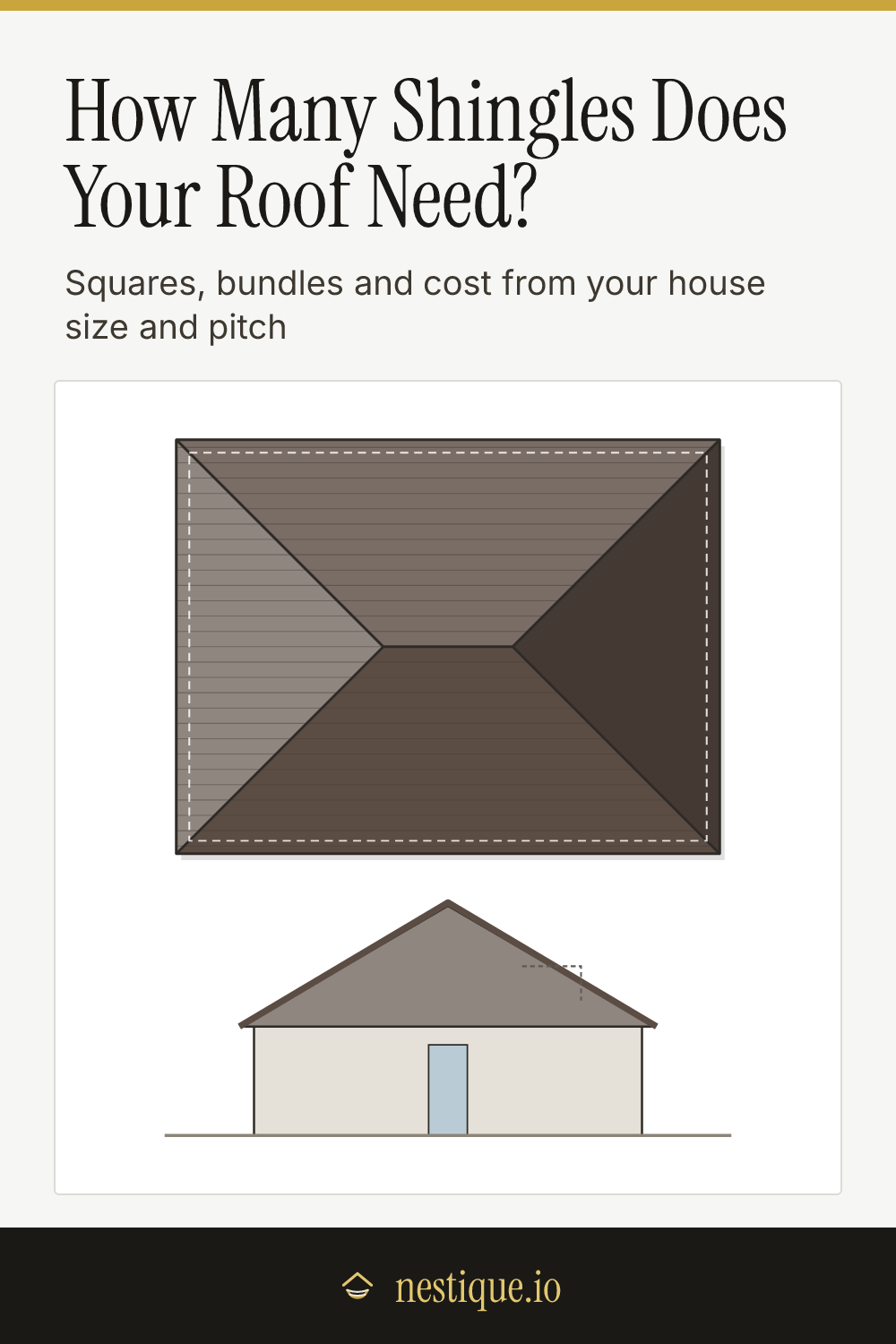
Choose the roof style at the top. A gable roof has two slopes that meet at a ridge, with triangular wall ends. A hip roof slopes down on all four sides.
Enter the house’s length and width, wall to wall, measured outside. Length runs along the ridge. Type feet and inches (40’ 6”) or a decimal (40.5), or tap the minus and plus buttons. If you already know the roof area from a roofer’s measurement, switch Measure by to Roof area and enter it instead.
Set the roof pitch, the inches the roof rises for every 12 inches it runs. You can measure it from the attic with a level and a tape, or count siding courses on a gable end. Most houses sit between 4/12 and 9/12. Then set the overhang, how far the roof runs past the walls.
The drawing shows the roof from above, with the walls dashed under the overhang, and the end of the house with the pitch drawn to scale. The results list the roof area, squares, shingle bundles, underlayment rolls, drip edge, ridge cap and starter strip.
Below that, tap any of the three roof types to see its installed cost. Turn on Tear off the old roof if the old shingles come off first. Open Edit the prices to put in the price per square from your quotes, and save the result as an image to compare bids.
The rules behind the estimates
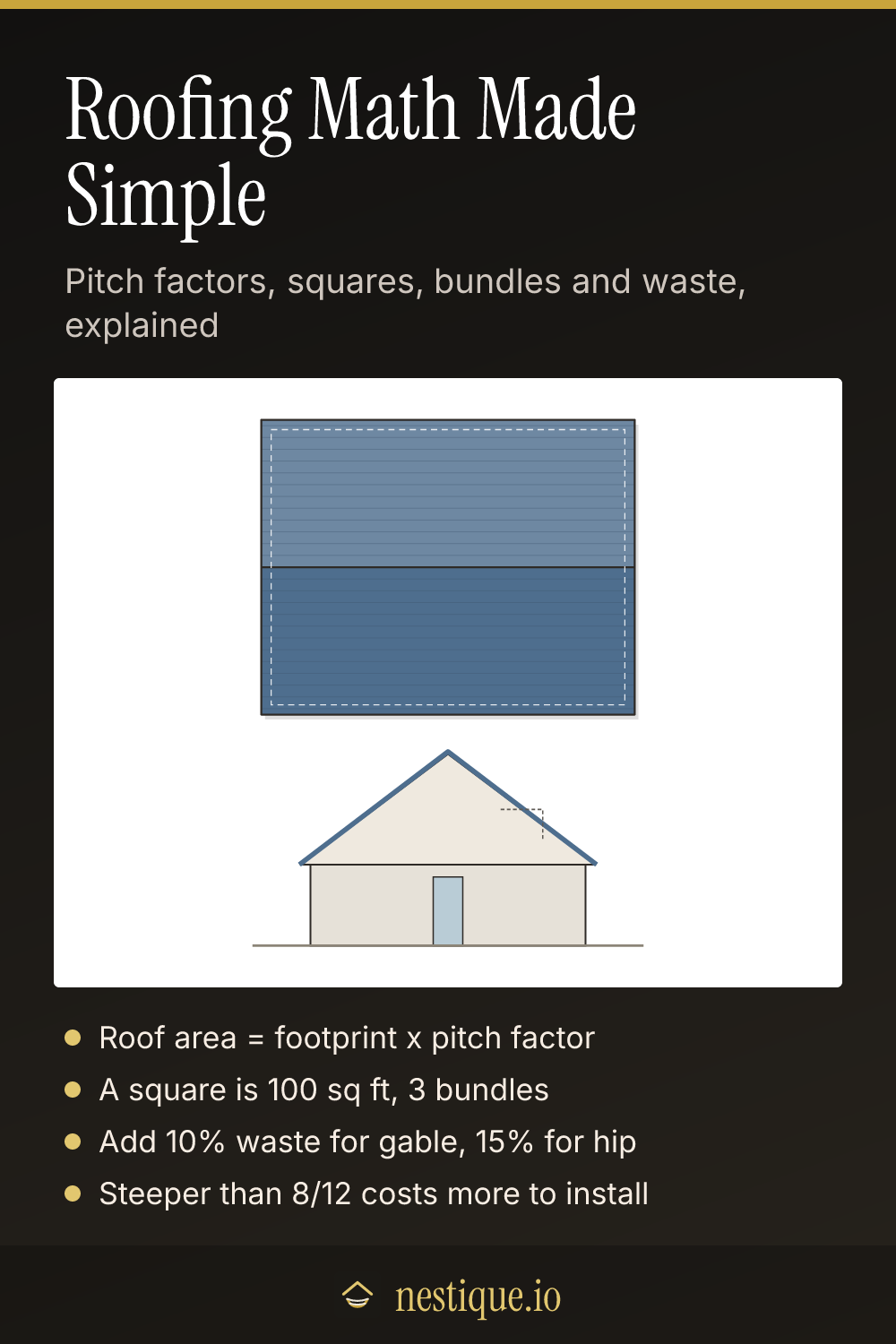
Pitch makes the roof bigger than the house. With every slope at the same pitch, the roof area is the plan area times the pitch factor, the square root of 1 plus the rise over 12, squared. That is about 1.05 for a 4/12 roof, 1.118 for 6/12, 1.202 for 8/12 and 1.414 for 12/12. A gable and a hip roof over the same house at the same pitch have the same area.
A square is 100 square feet, and shingles come 3 bundles to the square. That holds for standard 3-tab and most architectural shingles. Heavier designer shingles can come 4 or 5 bundles to the square, so check the wrapper.
Waste is about 10% for a gable roof and 15% for a hip roof. Every row ends in a cut, and hips need extra cut pieces. Roofs with valleys, dormers and skylights can need 20%.
Underlayment rolls cover about 9 squares. A synthetic roll is 10 squares, and the side and end laps use about a tenth of it. Between 2/12 and 4/12, shingle makers and the building code call for two layers.
Drip edge runs along every edge, ridge cap along the top. On a gable roof the drip edge covers the two eaves and the four sloped rake edges. On a hip roof every edge is an eave. Ridge cap covers the ridge, and on a hip roof the four hips too. Starter strip goes along the same edges as the drip edge.
Steep roofs cost more to install. From about 8/12 up, roofers need roof jacks and harnesses, and they charge roughly 10 to 25% more.
Assumptions
The house is a rectangle with one simple roof, no valleys, dormers, chimneys or skylights. For a house with wings, run each rectangle on its own and add the results. In roof area mode, edge lengths are estimated for a typical 3:2 house shape.
Installed prices are typical 2026 US ranges per square, gathered from commonly published cost guides, and include underlayment, drip edge, ridge cap, flashing and normal waste. Replacing rotten decking, new gutters, skylights and permits are extra. Material counts are rounded up to whole bundles, rolls and pieces.
Worked example
Say the house is 40 by 30 feet with a 6/12 gable roof and a 12 inch overhang. With the overhang, the roof covers 42 by 32 feet, a plan area of 1,344 square feet. The 6/12 pitch factor of 1.118 makes the roof 1,503 square feet, or 15 squares.
- Shingles: 15 squares plus 10% waste is 16.5 squares, or 50 bundles.
- Underlayment: 1,503 square feet at 900 per roll is 2 rolls.
- Drip edge: two 42 foot eaves plus four 17.9 foot rakes is about 156 feet, 16 pieces.
- Ridge cap: the 42 foot ridge takes 2 bundles. Starter strip takes another 2.
Installed, architectural shingles come to $7,510 to $12,800, 3-tab asphalt $6,010 to $9,770, and standing-seam metal $15,000 to $25,500. Tearing off one old layer adds $1,500 to $3,760, bringing the architectural roof to $9,020 to $16,500.
The same house with a hip roof needs 52 bundles at 15% waste, and its 10 foot ridge plus four 24 foot hips take 4 bundles of ridge cap.
Paying for the project
A new roof is hard to put off once it starts leaking, and many homeowners compare home equity line of credit rates before signing a contract. Knowing the low and high totals first helps you decide how much, if anything, to borrow.
Pin it for later
Roofing Calculator FAQ
How do I calculate how many squares my roof is?
Multiply the house length and width, each plus the overhang on both sides, to get the plan area. Multiply that by the pitch factor (1.118 for a 6/12 roof, 1.202 for 8/12) to get the sloped roof area, then divide by 100. A 40 x 30 ft house with a 12 in overhang and a 6/12 roof is about 15 squares.
How many bundles of shingles do I need?
Standard and architectural shingles come 3 bundles to a square, so multiply the squares by 3 after adding waste: about 10% for a gable roof and 15% for a hip roof. The 15 square roof in the example needs 50 bundles with 10% waste.
How much does a new roof cost in 2026?
With typical US prices, an architectural shingle roof costs about $500 to $850 per square installed, 3-tab asphalt about $400 to $650, and standing-seam metal about $1,000 to $1,700. A 15 square roof comes to about $7,510 to $12,800 in architectural shingles, plus $1,500 to $3,760 to tear off one old layer.
Does roof pitch change how much material I need?
Yes. A steeper roof covers more area over the same footprint. A 4/12 roof is about 5% bigger than its footprint, a 6/12 roof 12%, an 8/12 roof 20% and a 12/12 roof 41%. Roofs from about 8/12 up also cost more to install because they are too steep to walk safely.
What is the difference between a gable and a hip roof?
A gable roof has two slopes that meet at a ridge, with triangular wall ends. A hip roof slopes down on all four sides, so it has a shorter ridge plus four hips. With the same footprint and pitch they have the same area, but a hip roof needs more ridge cap and more waste for the cuts along the hips.