How to use the stair runner calculator
Choose the installation style at the top. A waterfall runner drops straight from the front of each nosing to the next tread. A Hollywood runner is wrapped under each nosing and fastened tight down the riser. Hollywood looks more tailored and takes a little more runner.
Count the steps. Count every step you climb, including the last one up onto the upper floor. Most flights between two floors have 12 to 16.
Then measure one step with a tape:
- Tread depth: from the riser at the back to the front edge of the nosing.
- Riser height: from the top of one tread to the top of the next.
- Nosing: how far the front edge of the tread sticks out past the riser below it. It is usually about an inch.
- Stair width: wall to wall, or wall to the outside edge on an open stair.
If the runner continues across a landing, turn on the landing switch and enter how far you walk across it.
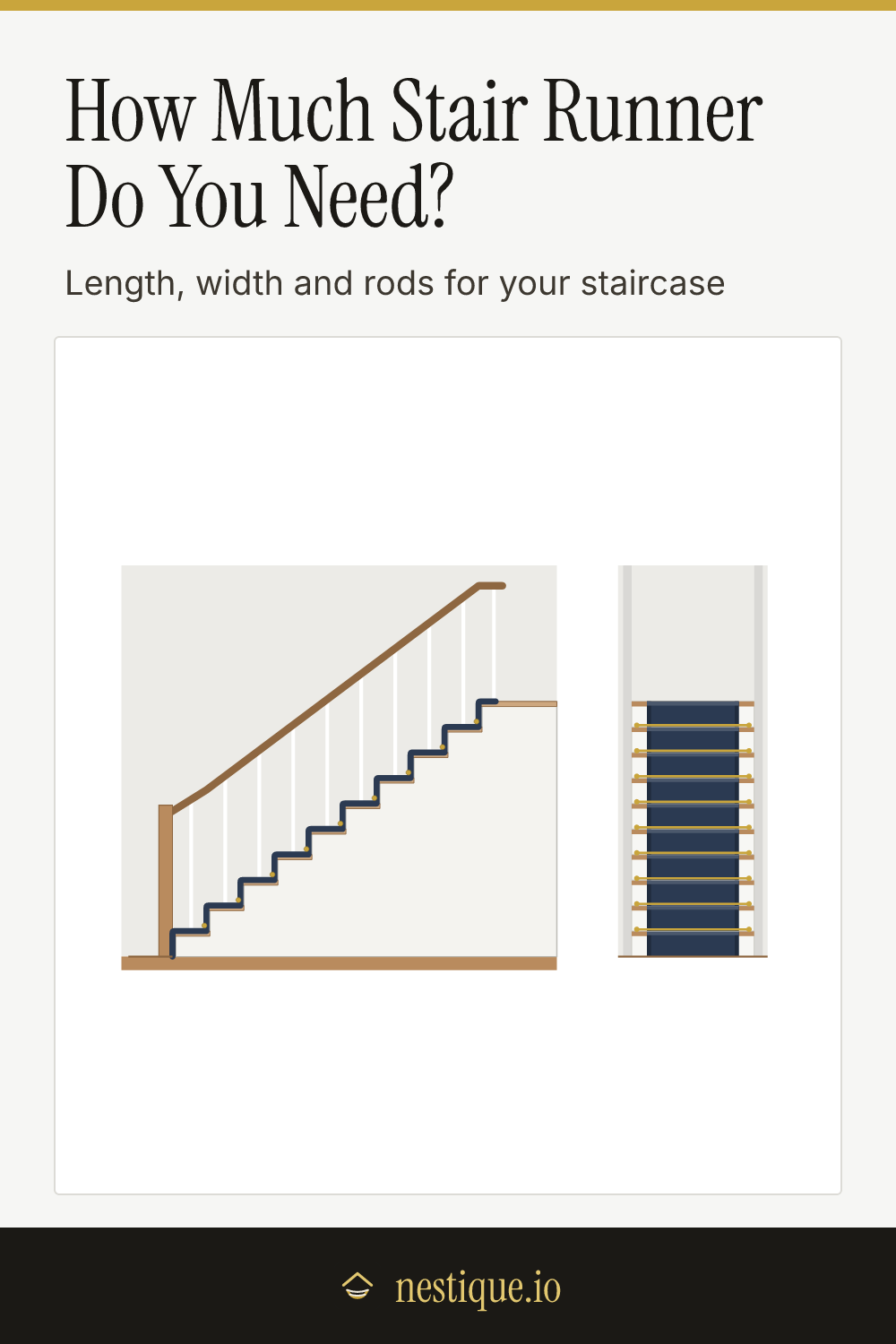
The drawing shows your stairs from the side and from the front. Tap through the runner widths under it. Each one is marked as a good fit, too narrow or too wide, and the one marked Best leaves the classic amount of wood showing. Save the picture to take to a runner shop or to send to an installer.
The rules behind the numbers
Every step takes a tread, a riser and a nosing. The runner climbs each riser, goes over the nosing and runs back across the tread. Going over a nosing uses about half an inch more than the flat measurements suggest. A Hollywood install also tucks back under the nosing, which adds the nosing depth again on every step.
The top step is the floor. A flight with 13 steps has 13 risers but only 12 treads, because the last step lands on the upper floor. The runner covers all 13 risers and nosings and the 12 treads between them.
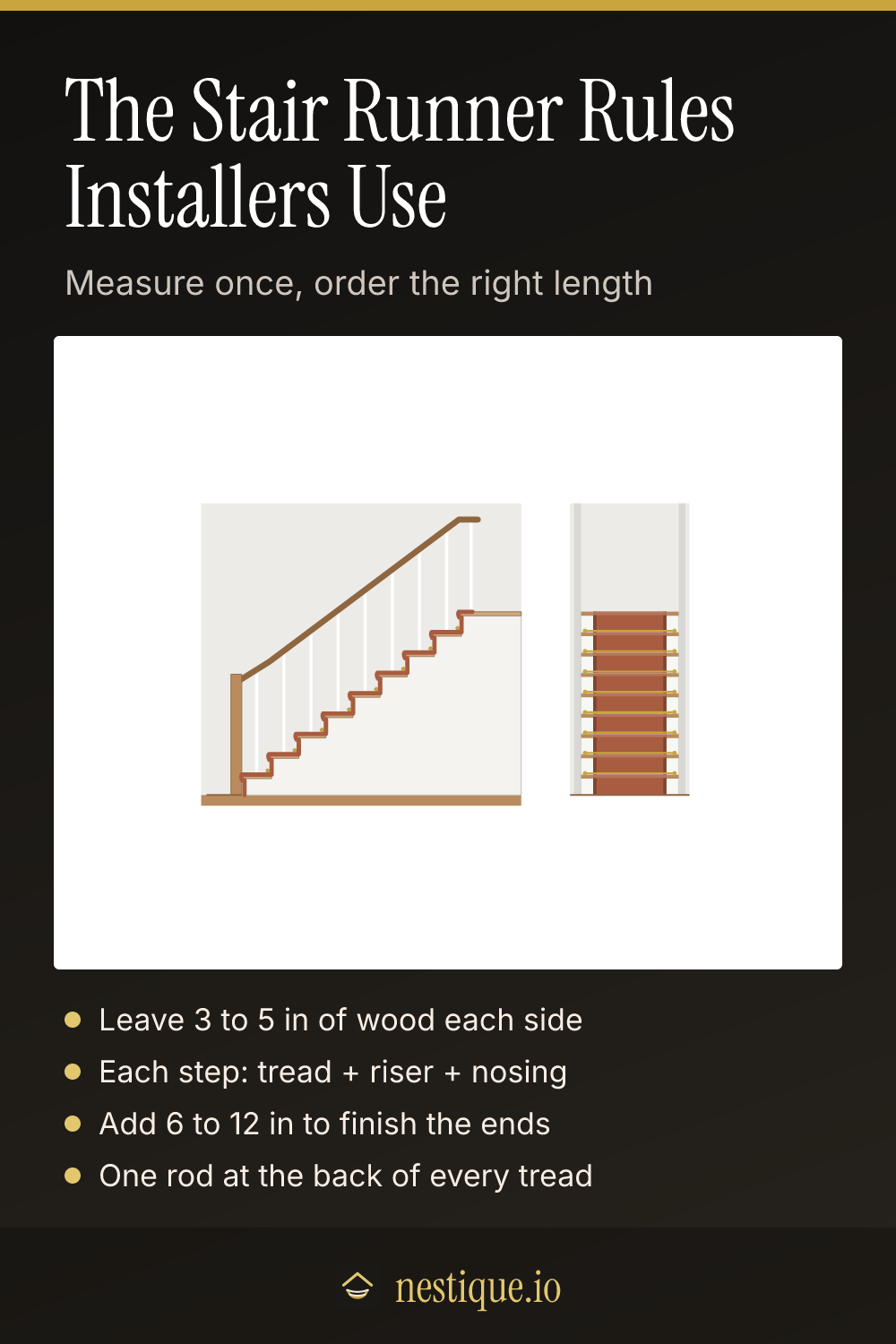
Add 6 to 12 inches to finish. The ends are turned under, bound or tucked, and the first and last steps take some fiddling. The calculator adds 9 inches, the middle of that range. Runner is sold by the foot, so the order is rounded up to the next whole foot.
Leave 3 to 5 inches of wood each side. Less than 3 inches and the runner looks like wall-to-wall carpet. More than 5 and it looks skimpy. About 4 inches is the classic look. Standard runners come 27, 30, 32 and 36 inches wide, so on most stairs one or two of them land in range.
One rod per tread. Stair rods sit in the crease at the back of each tread, so a runner over 12 treads takes 12 rods. Each rod takes two brackets, and the rod should be about 3 inches longer than the runner on each side so the brackets sit clear of the edges.
Assumptions
All the steps are the same size, which building codes require within a flight, so measuring one is enough. Winder steps, curved stairs and pie-shaped landings are not modeled. Measure those step by step along the line where you will walk and add them up.
The landing is treated as one extra-deep tread in the middle of a straight flight. If the stairs turn at the landing, the runner is usually made in two pieces with a joint or a mitred turn, so ask the installer how much extra they want.
Runner thickness is not modeled. Thick, plush runners over a pad use slightly more length over each nosing, so round up if your runner is unusually thick. Rods are optional. Many runners are stapled or tacked in place without them.
Worked example
Say your stairs have 13 steps, 11 inch treads, 7 1/2 inch risers and a 1 inch nosing. The stairs are 36 inches wide and you want a waterfall runner.
- Per step: 11 + 7 1/2 + 1/2 for going over the nosing = 19 inches.
- Length: 13 risers at 8 inches each (riser plus the nosing curve) is 104 inches. Add 12 treads at 11 inches, 132 inches, for 236 inches.
- Finishing: add 9 inches for 245 inches, or 20 ft 5 in. Order 21 ft.
- Width: a 27 inch runner leaves 4 1/2 inches of wood each side, the best fit. A 30 inch runner leaves 3, which is still fine. A 32 inch runner leaves only 2, which is too wide.
- Hardware: 12 rods, each at least 33 inches long, and 24 brackets.
Switch to a Hollywood install and each step uses another inch to tuck under the nosing. The total grows to 21 ft 6 in, so order 22 ft. Add a 36 inch landing to the original waterfall runner and it grows to 22 ft 6 in, so order 23 ft.
Pin it for later
Stair Runner Calculator FAQ
How long a runner do I need for 13 stairs?
A typical flight of 13 steps with 7 1/2 in risers and 11 in treads needs about 20 ft 5 in of runner for a waterfall install, including 9 in to finish the ends. Runner is sold by the foot, so order 21 ft. A Hollywood install, wrapped under each nosing, needs about a foot more.
How wide should a stair runner be?
Leave 3 to 5 inches of wood showing on each side. On a standard 36 inch stair, a 27 inch runner leaves 4 1/2 inches each side and a 30 inch runner leaves 3. Wider stairs of 40 to 42 inches suit a 32 inch runner.
How do you measure stairs for a runner?
Count the steps, then measure one tread from the riser to the front of the nosing and one riser from the top of one tread to the top of the next. Multiply each by the number of steps, add a little for going over each nosing, and add 6 to 12 inches to finish the ends.
What is the difference between a waterfall and a Hollywood stair runner?
A waterfall runner drops straight down from the front of each nosing to the next tread, leaving a small gap under the nosing. A Hollywood runner is wrapped tight around the nosing and fastened down the riser. Hollywood looks tailored and uses a little more runner.
How many stair rods do I need?
One rod for each tread the runner covers, which is usually one fewer than the number of steps, because the top step is the upper floor. Each rod takes two brackets. Rods should be a few inches longer than the runner is wide so the brackets sit clear of it.